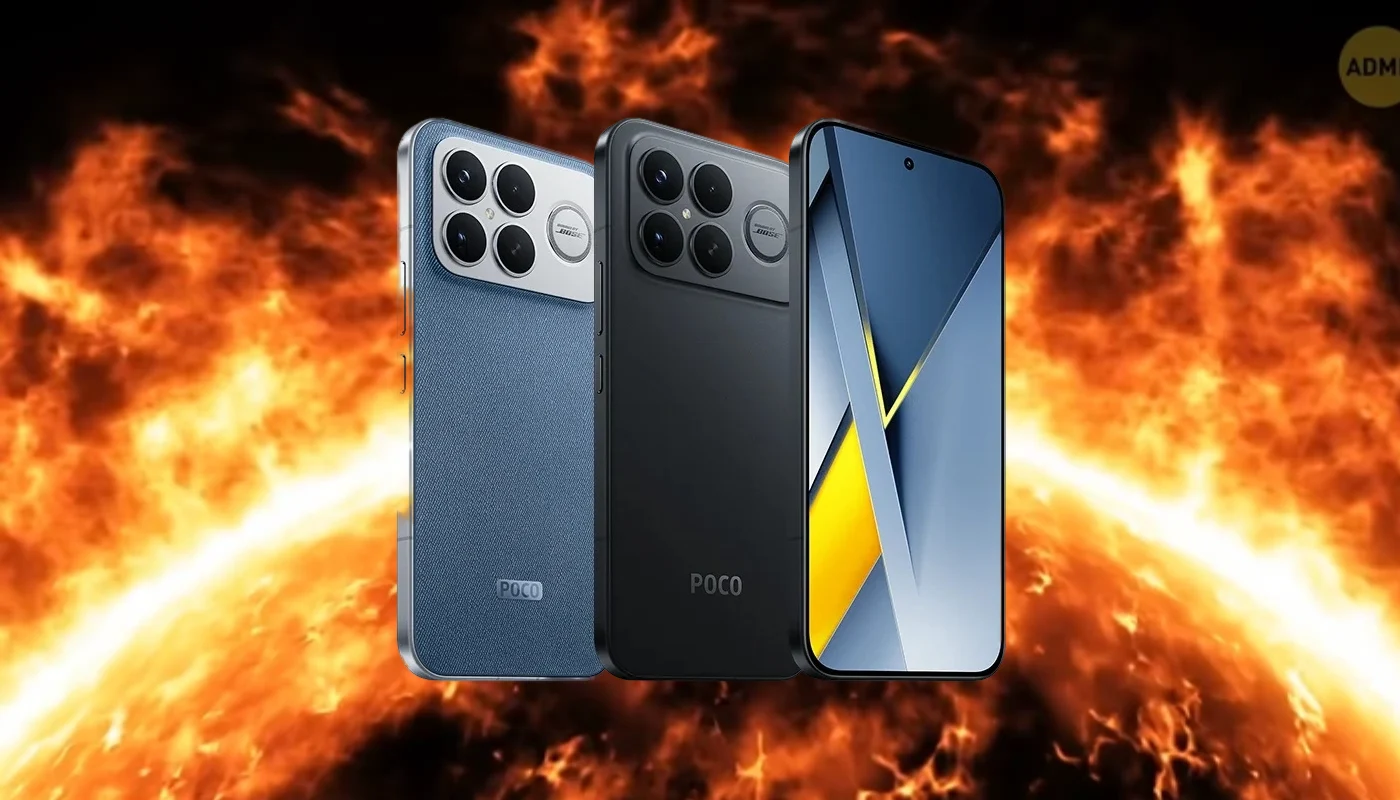
If you’ve just unboxed your POCO F8 and it’s burning your hands, you’re not alone. Forums and Reddit are flooded with identical posts: “the phone is on fire,” “the battery is melting,” “is this normal or a defect?”. We’ve gathered everything real owners are reporting.
“It was boiling for three days”
The majority of complaints surface during the first few days after purchase. Users report that during setup, data transfer, and app installation, the chassis gets genuinely hot. Meanwhile, the battery percentage can plummet in just a few hours.
But here is the interesting part: a few days later, updates from the very same authors start appearing in those identical threads. “It stopped on day five,” “everything is fine now, don’t worry,” “just leave it alone.” Most owners note that after 4–5 days, the temperature drops significantly, and the phone behaves differently.
As for why this happens—users suggest that HyperOS is indexing files in the background and optimizing the system for the specific device. However, these are just forum theories, not an official stance.
In games, it’s a different story
While everyday performance improves after the “break-in” period, gaming presents a consistent picture: it heats up. Running Genshin Impact or Honkai: Star Rail at maximum settings heats the chassis up to 42–44°C within 20–30 minutes. Owners note that the screen dims on its own during these sessions—the phone lowers the brightness to drop the temperature.
The aluminum frame is a double-edged sword in this regard: on one hand, the heat dissipates outward quickly, and you feel it immediately. On the other hand, at least it doesn’t stay trapped inside. Still, holding a “hot brick” while gaming isn’t comfortable for everyone.
Why else it might heat up: community theories
A separate category of complaints involves the phone getting warm not during games, but out of nowhere. Reddit users are digging deeper here and blaming HyperOS: ad services, Xiaomi analytics, and background processes run constantly, stressing the processor even when the phone is just sitting on a desk.
Some owners resort to debloating via ADB, removing system junk using a PC. Following this, they report that the device runs noticeably cooler and the battery lasts longer. However, that’s a whole different story with its own risks, and not everyone is ready to do it.
Is it time to upgrade to the F8?
While some are troubleshooting overheating issues, others are wondering about something else entirely: is the F8 even worth buying if you already own an F5 or F6? This topic is being discussed just as actively on forums and Reddit.
If you have an F5 or older, there isn’t much debate. You get a leap across two chip generations, aluminum instead of plastic, and a proper zoom lens instead of a 2 MP macro filler. F5 owners say it feels like a completely different class of device. Plus, the battery has jumped to 6,000+ mAh compared to the old 4,500 mAh.
If you have an F3 or F4, people are mostly upgrading due to degraded batteries and the end of software support. For them, the F8 is a whole new world: a screen reaching up to 3,500 nits, an ultrasonic under-display fingerprint scanner, and a battery that is nearly 1.5 times larger.
If you have an F6 or F6 Pro, the community is unanimous: it makes little sense. The Snapdragon 8s Gen 3 or 8 Gen 2 are still more than enough for everything. The only reasons to switch are if you absolutely need the massive battery life of the new cells or a dedicated telephoto lens for photos. In all other cases, the advice is to wait for the next generation.
Get breaking news on WhatsApp
Більше новин в телеграмі