At CES 2026, information surfaced about an unplanned demonstration of a new panel from Samsung Display that, by indirect signs, is being developed for Apple. The panel has not reached retail and has not been officially announced.
The booth featuring the display was available only for a very short time. It appeared on the show floor and was then removed quickly. Whether this was a mistake or a controlled leak has not been officially confirmed. Neither company commented on the situation.
We believe—and this is strictly the editorial opinion—that Apple is using this to build interest in its upcoming products
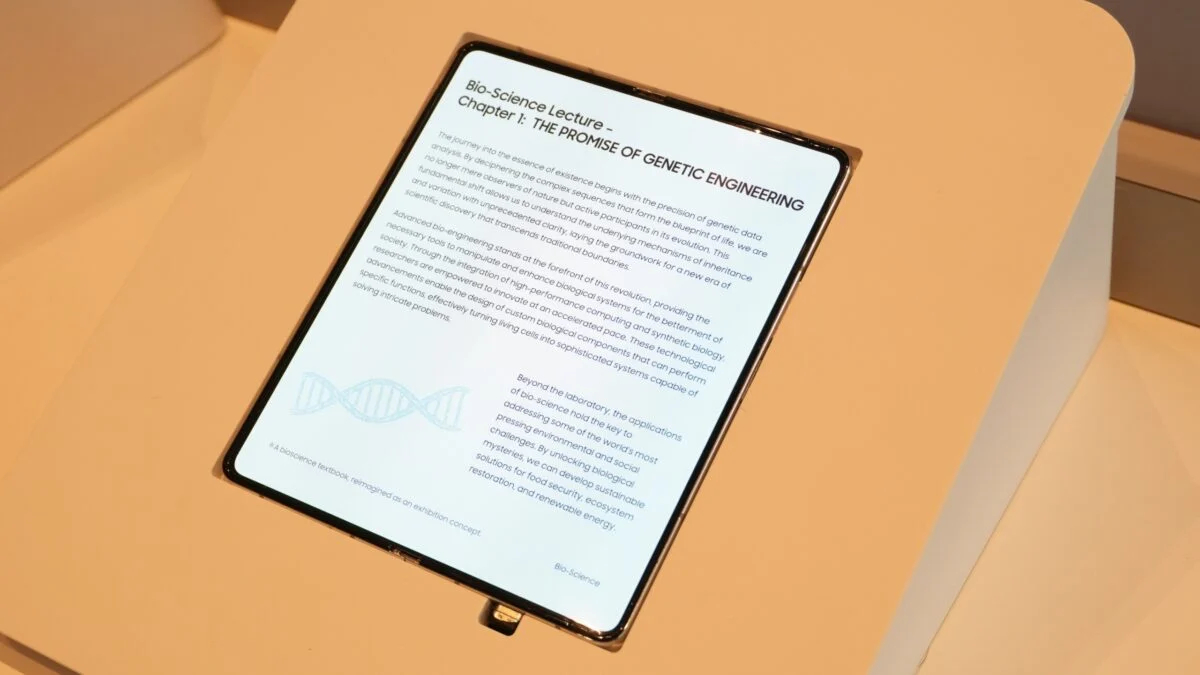
Based on videos recorded by attendees, the panel looked completely flat. There was no visible crease—the core issue that still defines most foldable screens. At the same time, the display was positioned at a distance and no one handled it directly, which makes it impossible to draw final conclusions.
What was actually seen at the Samsung Display booth
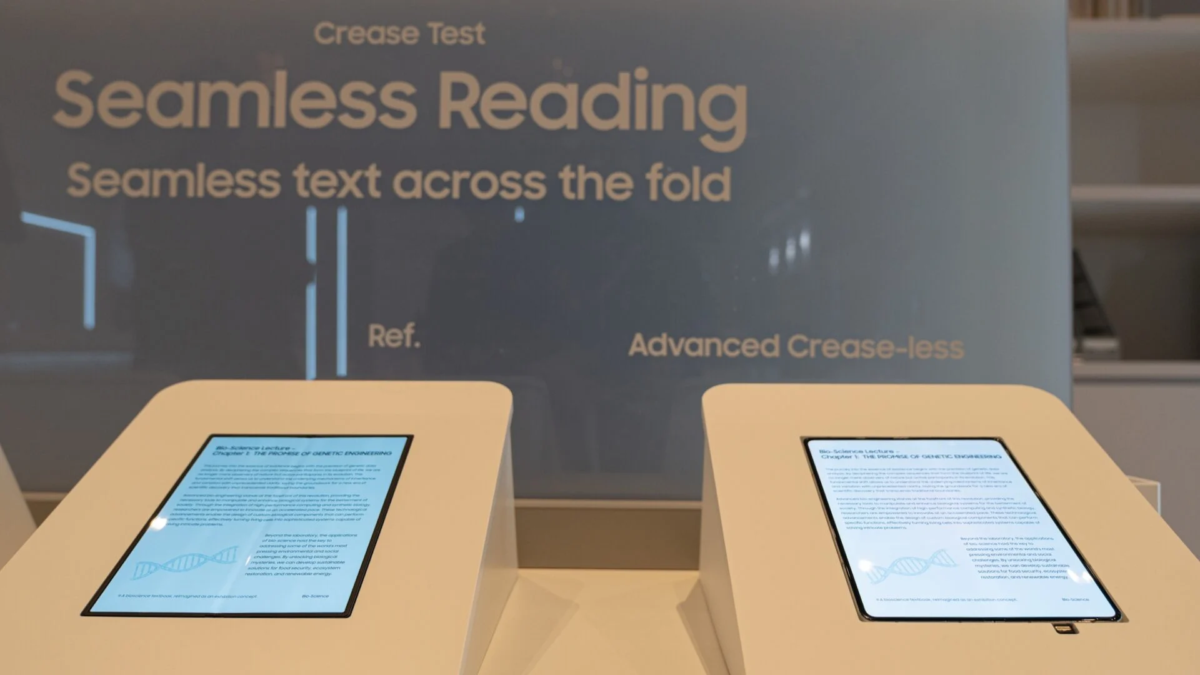
From a technical standpoint, this appears to be a next-generation foldable OLED display. Samsung Display is Apple’s primary supplier of flexible OLED panels, and the company has spent years investing in reducing—or fully eliminating—the crease along the fold line.
In CES 2026 footage, the display looked flat when unfolded. There were no obvious kinks or lighting distortions in the center. The panel was shown without a device chassis, as a standalone module, and there were no visible placards or product names nearby.
It is important to note that this kind of appearance alone does not confirm mass-production readiness. Samsung Display has previously shown prototypes that were years ahead of consumer products, so a CES sighting does not automatically mean a commercial launch.
The display was removed from the booth quickly
The lack of an official explanation leaves room for interpretation, but the tech industry has a long-standing practice of releasing information in measured doses. Both Samsung and Apple are known for not showing key developments by accident—especially when the technology has not been announced.
Most likely, the panel was an experimental sample and was not intended for a full public showcase. It is also possible that its brief appearance fell outside partner agreements, or that it was meant for a limited set of meetings rather than general visitor traffic.
At the same time, the very fact that the display appeared only briefly is difficult to call neutral. In an industry where every signal is tightly managed, even a few minutes on the show floor can act as an information trigger. That is why a deliberately limited demonstration can look just as plausible as an organizational mistake.
The editorial team notes that none of these versions has official confirmation. The “accidental” scenario is not supported by sources and remains an analytical assessment rather than an established fact.
Why this display is being linked specifically to Apple
According to Ice Universe, this type of Samsung crease-free display is expected to be used in Apple’s first foldable smartphone—often referred to unofficially as the iPhone Fold. That fits Apple’s long-running position: it has stayed out of the foldables market while compromises remain too visible.
Apple has delayed a foldable device for years, and the display is widely seen as the key barrier. A visible crease conflicts with Apple’s definition of a finished product. If Samsung Display has truly solved this at the hardware level, it removes one of the biggest obstacles to an iPhone Fold.
There is still no information about timing, the final form factor, or the software experience. For now, this remains a technology signal—not confirmation of a ready-to-ship device.
The story echoes the iPhone SE that everyone expected
It is hard not to think of the iPhone SE era—when the market felt confident it knew Apple’s next move. Many expected a kind of “iPhone 4 SE”: a compact body, familiar design language, and modern internals. Expectations were widespread, leaks were constant, and confidence was close to absolute.
But Apple chose a different route. Instead of repeating an old form factor directly, the company rethought the approach and moved in another direction. On paper, the audience’s expectations made sense, yet strategically Apple refused to follow a script written by the market. That is why many people felt a gap between what “should have launched” and what Apple actually delivered.
The foldable iPhone situation feels similar. The market has already pictured an iPhone Fold, fans are ready to buy, insiders are fueling interest, and the crease-free display sighting at CES 2026 only intensified expectations. But just like with the iPhone SE narrative, that does not mean Apple will take the most obvious path—or ship exactly the product everyone thinks is coming.
What can be said for sure at this stage
A crease-free display prototype does not mean an iPhone Fold is finished or close to release. It is more of a sign that Apple and Samsung Display are in a phase of testing market reaction rather than presenting a product. The same pattern once surrounded compact iPhones, which ultimately arrived in a form very different from what people expected.
For now, only a few things can be treated as confirmed. At CES 2026, a prototype flexible display without a visible crease was indeed spotted and appeared briefly at the Samsung Display booth. No statements were made about a commercial product.
Everything else remains expectation, analysis, and speculation. Whether this display becomes the foundation of an iPhone Fold or stays a lab experiment is still unknown. But the interest is already there, and the market is watching every new signal from Apple and Samsung.
Більше новин в телеграмі