
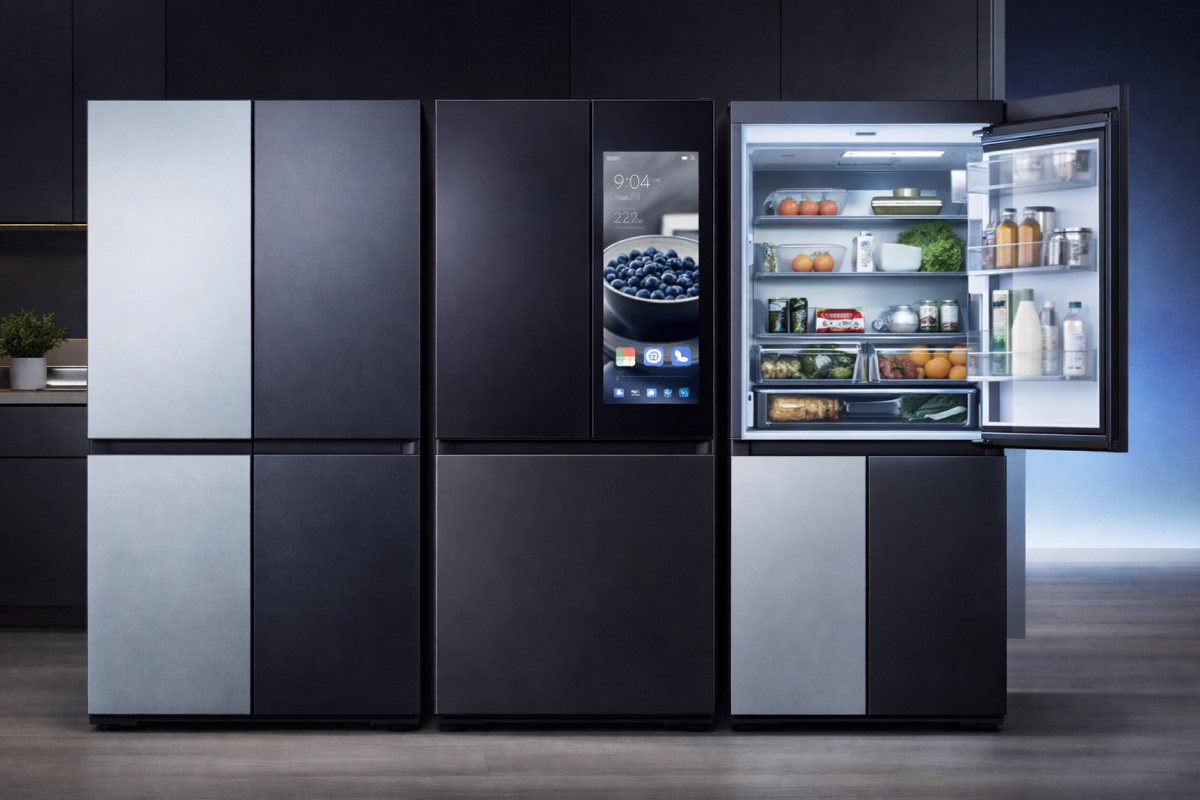
Refrigerators stopped being “quiet” background appliances a long time ago. In Samsung’s case, they are gradually turning into a full-fledged part of a digital ecosystem, where the software platform, artificial intelligence, and interaction with other devices play the central role. That’s why Samsung refrigerators are increasingly discussed in the context of CES 2026 not as standalone products, but as part of a broader strategy for AI-powered home appliances.
In this context, it’s no coincidence that Samsung’s AI appliance direction is being actively discussed ahead of CES 2026 — a show that traditionally sets the direction for consumer electronics. That is where the company is expected to present the next stage of integrating artificial intelligence into refrigerators and the SmartThings ecosystem, shifting the focus from isolated features to a platform-driven approach.
This approach is fundamentally different from the classic idea of a “smart fridge.” It’s not about a screen on the door or a Wi-Fi connection — it’s about building a system where the kitchen becomes part of a unified digital home environment.
How Samsung arrived at the idea of the refrigerator as an ecosystem component
The evolution of Samsung refrigerators didn’t start with AI, but with the idea of making the kitchen interactive. Early generations of Family Hub were an attempt to turn the refrigerator into an information center — with a calendar, notes, and media. Over time, however, it became clear that the screen alone doesn’t create value without deeper integration.
The next step was connecting refrigerators to the SmartThings platform. That’s where Samsung began treating the refrigerator not as a standalone device, but as part of a network of home appliances, smartphones, TVs, and sensors. This shift from “a device with features” to “a node in the system” became the foundation for the next phase of AI development.
What already exists today: Bespoke AI, Vision Inside, and SmartThings
Modern Samsung refrigerators in the Bespoke AI lineup combine hardware components with software logic. Cameras inside compartments, temperature and humidity sensors, and AI Vision Inside allow the system not only to register what’s inside, but to build a structured understanding of the refrigerator’s contents.
The key difference from most “smart solutions” lies in ecosystem interaction. Through SmartThings, the refrigerator syncs with a Samsung smartphone, tablet, or TV. Instead of separate controls for each device, the user gets a unified logic of management — with the fridge as just one element in a connected environment.
Importantly, a significant part of the functionality is implemented through software. That means the device’s value grows not only thanks to the hardware, but also through platform updates over time.
Gemini AI and a new level of artificial intelligence integration
Bringing Gemini AI into Samsung home appliances changes the role of AI inside refrigerators. If earlier algorithms handled narrowly defined tasks — object recognition or basic suggestions — the focus now shifts toward contextual data processing.
Gemini AI works not only with what’s inside the fridge, but also with user behavior patterns. This enables the system to analyze shopping routines, shifts in eating habits, and adapt recommendations without constant manual input. In the CES 2026 context, Samsung is signaling that AI becomes a platform component rather than a standalone feature.
The refrigerator as a smart home hub
One key idea that competitors often ignore is Samsung’s choice of the refrigerator as an ecosystem hub. Unlike a smartphone or a TV, a refrigerator is always online, runs 24/7, and has stable access to everyday household signals.
Via SmartThings, the fridge can interact with other appliances — from ovens to lighting systems. In this scenario, it stops being “a device in the kitchen” and becomes a data collection point for the entire home ecosystem. This is the approach that allows Samsung to build a long-term smart home strategy.
Software: One UI, SmartThings, and updates
The software layer deserves special attention. Samsung is extending One UI logic into home appliances, unifying interfaces across smartphones, TVs, and refrigerators. This lowers the learning curve and increases the overall value of the ecosystem.
In practice, a refrigerator in 2026 becomes a device with its own operating logic, update support, and a software dependency comparable to that of a smartphone. For the tech market, this shifts attention from pure hardware specs toward long-term software support.
How Samsung’s approach differs from LG and other manufacturers
Unlike many competitors, Samsung doesn’t reduce AI to a set of separate features. LG ThinQ and other platforms may offer similar capabilities, but often without deep cross-device integration.
Samsung’s strategy is about building a single environment where the refrigerator, TV, and smartphone work under a shared logic. That doesn’t guarantee a perfect experience today, but it creates the foundation for ecosystem scaling in the future.
What will change after CES 2026
CES 2026 is likely to be the point where Samsung formalizes this platform approach. Next-generation refrigerators are expected to gain deeper AI integration, richer contextual awareness, and greater autonomy in decision-making.
For the home appliance market, this implies a shift toward a model where a product’s value is defined not only by specifications, but by its role within an ecosystem. The refrigerator stops being a final standalone product and becomes part of a broader platform.
Samsung refrigerators in 2026 are no longer just home appliances — and not even “smart devices” in the traditional sense. They are elements of an AI ecosystem where software, integration, and a long-term development strategy are the key drivers.
This approach helps Samsung stand out against competitors and shape a new vision of the smart kitchen. And that is exactly why the topic of Samsung refrigerators goes beyond household reviews and becomes a full-fledged tech direction worth watching.
Більше новин в телеграмі





One thought on “Samsung’s next-generation refrigerators: how an AI kitchen ecosystem is taking shape”