
Samsung is approaching CES 2026 differently than before
The company is preparing one of its most ambitious presentations in recent years. At CES 2026, Samsung plans to showcase not just new gadgets, but complete ecosystems where artificial intelligence becomes a core element of everyday life, entertainment, and home content. According to leaks, the focus is on three key directions that directly affect daily user experience.
As the consumer electronics market becomes saturated with similar solutions, Samsung at CES 2026 is shifting the focus from raw specifications to real-world usage scenarios. The integration of Gemini AI into home appliances, the launch of the new Music Studio audio lineup, and the preparation of Micro RGB TVs appear not as isolated announcements, but as parts of a single strategy.
What matters is that all these products fit into the broader context of Samsung’s AI ecosystem. This includes home appliances that analyze habits, audio systems that function as part of a unified environment, and televisions that become the center of the home not only because of their size, but also because of advanced content processing. That is why Samsung’s CES 2026 announcements attract attention not only from brand fans, but from the entire consumer electronics market.
Home appliances with Gemini AI: the refrigerator becomes more than just an appliance
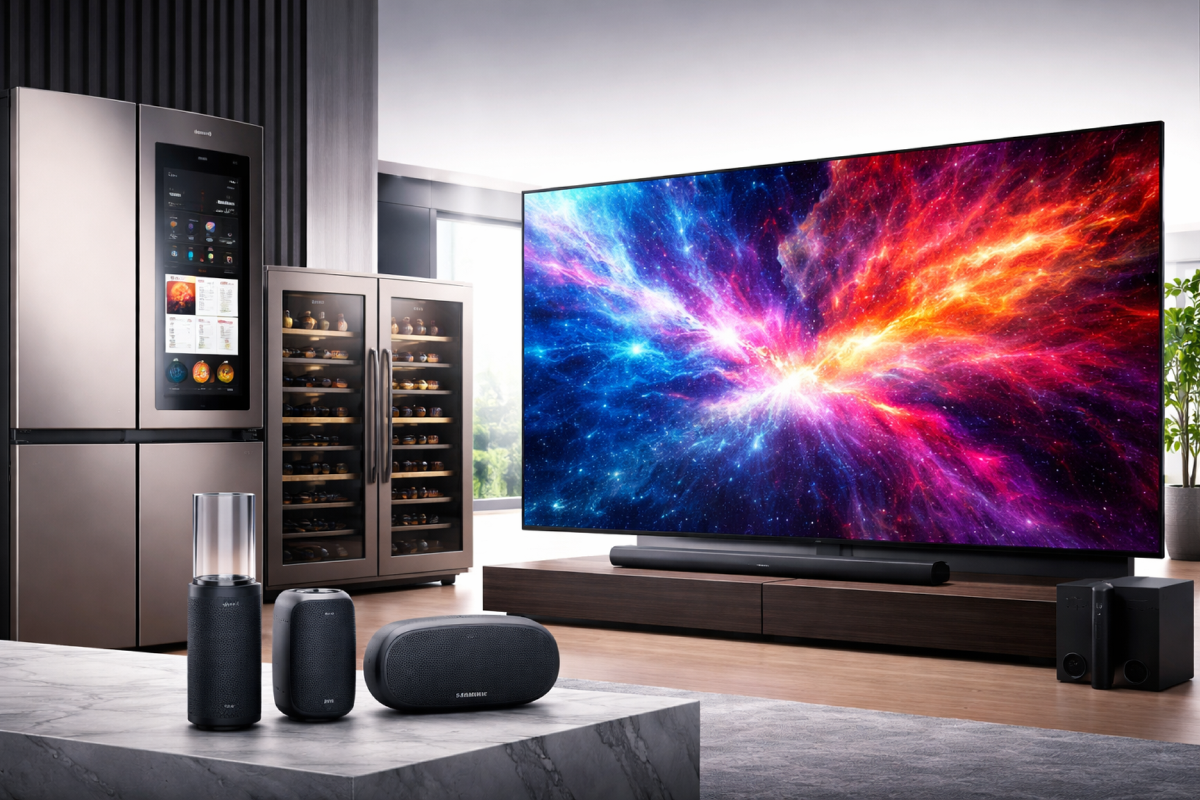
The most illustrative move from Samsung at CES 2026 is the integration of Gemini AI into home appliances. This primarily applies to premium refrigerators and wine coolers, but the concept extends far beyond a single product category. Samsung is rethinking the role of home appliances, transforming them from “smart screens” into active elements of a connected ecosystem.
It is important to understand that Gemini AI in a refrigerator is not a traditional voice assistant. According to leaks, the system analyzes contents, user habits, shopping patterns, and kitchen usage scenarios. The refrigerator can suggest meals based on available ingredients, warn about expiration dates, adapt storage modes for specific products, and fit into the overall logic of a smart home.
This is where Samsung emphasizes something competitors often overlook. Many articles describe AI appliances as just another gadget with a large display. In Samsung’s case, however, the key element is not the screen, but the connection between devices. The refrigerator, smartphone, television, and audio system operate within a single environment, using data to simplify everyday life rather than to showcase technology for its own sake.
Samsung also pays special attention to wine coolers and premium food storage solutions. Here, AI helps precisely control temperature, humidity, and storage modes based not only on preset profiles, but on real usage conditions. This shows that Samsung is targeting not only the mass market, but also users for whom home appliances are part of a lifestyle.
As a result, home appliances with Gemini AI represent the first step toward a home where devices do not merely respond to commands, but anticipate needs. This is the approach Samsung aims to establish as a new standard rather than an experimental feature.
Music Studio 5 and Music Studio 7: Samsung builds its own audio ecosystem
The second major direction Samsung is bringing to CES 2026 is audio. Here again, the company goes beyond individual devices. The Music Studio 5 and Music Studio 7 lineup appears to be an attempt to build a complete home audio ecosystem rather than simply adding more Wi-Fi speakers to the catalog.
Samsung clearly differentiates these models from traditional Bluetooth solutions. The focus is on stable Wi-Fi connectivity, multi-room playback, and deep integration with other devices in the home. In practice, Music Studio 5 and 7 are designed to function as part of a unified environment, where sound automatically adapts to the scenario — watching a movie, streaming a series, listening to music, or providing background audio throughout the day.
An important aspect often missed by competitors is the role of SmartThings and Q-Symphony. According to leaks, the new speakers do not exist independently of the television. They work together with Samsung TVs, enhancing sound, expanding the soundstage, and creating a unified system without complex setup or external receivers. For users, this means an easier path to high-quality home audio without diving into audiophile complexity.
Music Studio 5 and Music Studio 7 also signal a shift in Samsung’s approach to mass-market audio. The company aims to bridge the gap between simple speakers and expensive home theater systems. These products target users who want better sound without building a complex setup of separate components, cables, and configurations.
Within the context of CES 2026, this audio lineup logically extends Samsung’s overall strategy. Samsung is not selling sound as a standalone product, but as an experience that works in harmony with home appliances, televisions, and other devices. This approach is what distinguishes Music Studio from many competing solutions, where speakers remain isolated gadgets with limited integration.
Micro RGB TV: the next step after MiniLED
The third key direction for Samsung at CES 2026 is televisions with Micro RGB backlighting, positioned as a logical evolution after MiniLED. Unlike flashy concept products, this technology is intended for real-world scaling in large formats and gradual entry into the premium segment.
The core idea behind Micro RGB TV lies in more precise control of color and brightness at the backlight level. Instead of traditional white LEDs with filters, Samsung uses individual RGB elements, enabling cleaner colors, more stable contrast, and higher peak brightness. For viewers, this means not just a “brighter screen,” but a more natural image, especially in complex HDR scenes.
A critical nuance often overlooked is the role of AI processing in large formats. According to leaks, Micro RGB TVs work closely with image processing algorithms that adapt content to screen size, scene type, and viewing conditions. This becomes especially important for TVs 85 inches and larger, where any scaling imperfections are immediately visible.
Samsung is also betting heavily on ultra-large formats. This includes not only 100-inch models, but also even larger demonstration units. In doing so, the company emphasizes that the television becomes the physical and functional center of the home. Micro RGB TVs are positioned as an alternative to extremely expensive MicroLED panels, offering comparable quality at a more realistic price.
In the context of CES 2026, this direction is particularly revealing. Samsung is not trying to impress with a single specification, but is building an evolutionary path — from MiniLED to Micro RGB and toward a new category of image quality. This strategy allows Samsung to maintain leadership in the TV market while preparing consumers for even more significant changes ahead.
Why Samsung’s CES 2026 strategy is focused on an AI ecosystem
Samsung’s shift in 2026 is not driven by hype around artificial intelligence, but by real market constraints. Home appliances, televisions, and audio systems have become so complex that users no longer want to manage each device separately. That is why Samsung is focusing on an AI ecosystem where devices operate as a unified environment.
At CES 2026, Samsung effectively demonstrates a transition from “smart features” to AI-driven logic that connects the kitchen, sound, and screen. This reflects user demand for simplicity, predictability, and fewer manual adjustments in everyday life.
How Samsung’s new solutions will affect everyday use
For users, Samsung’s new approach changes the role of consumer electronics. Devices stop being isolated products and start functioning as a system that adapts to habits and scenarios.
AI-powered refrigerators, Wi-Fi audio, and large televisions no longer require constant attention or configuration. The focus shifts to home automation, where users interact with the ecosystem rather than with each gadget individually. This is particularly relevant for those who view their home as a long-term investment.
Samsung at CES 2026: what these announcements mean for the market
Samsung’s CES 2026 announcements demonstrate a systemic approach to consumer electronics. The company is not offering a revolution in a single product, but is building an environment where AI becomes an invisible yet constant part of how devices operate.
AI-powered home appliances, the Music Studio audio ecosystem, and Micro RGB TVs illustrate the direction in which the smart home will evolve in the coming years. Samsung is betting not on flashy specifications, but on scenarios designed to remain relevant beyond a single product upgrade cycle.
Більше новин в телеграмі



One thought on “Samsung bets on artificial intelligence: what the company is preparing for CES 2026”
Comments are closed.