Apple is preparing an unexpected move: a laptop powered by the processor from the iPhone 16 Pro. Can the A18 Pro realistically replace the M1/M2 series, how much RAM will it need for stable performance, and will professional software run smoothly on it? We break down the architecture, performance, and real-world limitations of a possible 2026 model.
In just two days, Apple may unveil its new MacBook powered by the A18 Pro. We don’t know all the details yet, but insider information allows us to analyze the technical foundation. Let’s try to understand what it means to move a “phone-class” chip into a laptop chassis.

Apple March 4 Event: A New Budget MacBook Could Debut Sooner Than Expected
The Apple Experience event could introduce a budget MacBook with A18 Pro, refreshed MacBook Pro models, and new Apple hardware.
Architecture and Process Technology
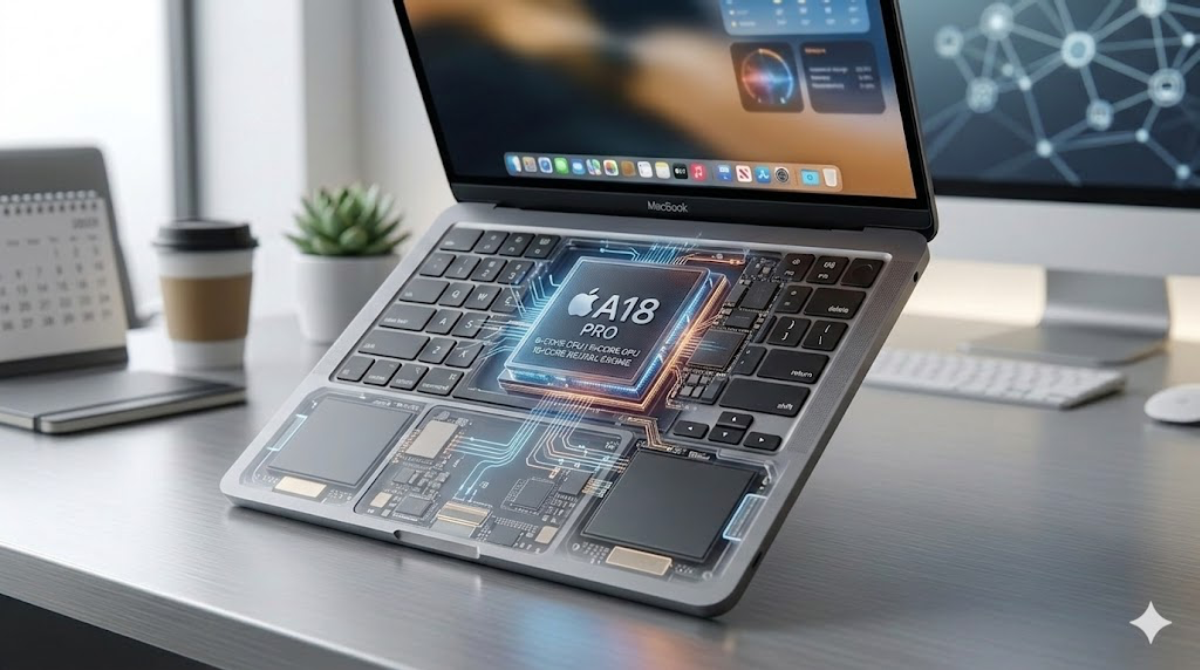
The A18 Pro is built on the second-generation 3nm process (N3E) from TSMC. This means higher energy efficiency and greater transistor density compared to the previous generation.
- CPU: 6 cores (2 performance + 4 efficiency), up to 15% faster than A17 Pro;
- GPU: 6 cores, approximately 20% faster than its predecessor.
Performance Compared to the M Series
In single-core tests, the A18 Pro performs at or above the base M1 level. In multi-core workloads, it approaches the M1 but falls behind the M2 due to fewer physical cores.
- 8 CPU cores in M1/M2 (4 performance + 4 efficiency);
- 7–8 GPU cores in M1;
- 8–10 GPU cores in M2.
For everyday tasks, the difference may be minimal, but under sustained workloads the M series remains more stable.
Specialization and Ports
| Specification | A18 Pro (iPhone 16 Pro) | M5 (iPad Pro / MacBook) |
|---|---|---|
| Cooling | Passive (throttles under load) | Passive (iPad) or active (Mac) |
| External Display Support | 1 external display | Up to 2 external 6K displays |
| Ports | USB 3.0 (10 Gbps) | Thunderbolt 4/5 (40–80 Gbps) |
| Artificial Intelligence | Optimized for text | Optimized for video and code |
Exceptional Battery Life
The chip was designed for a smartphone, which means extremely high energy efficiency. In a laptop, this could translate into 20+ hours of battery life.
Theoretical 25–30 hours are possible, but real numbers will depend on the display, brightness, and memory configuration.
Apple Intelligence and Neural Processing
- Neural Engine: 16 cores, up to 35 TOPS;
- Memory bandwidth increased by approximately 17%.
Everything depends on RAM. 8GB is the baseline minimum, while 16GB looks significantly more future-proof for 2026.

Apple AI Wearables: Glasses and Camera AirPods
Imagine a world where the person standing next to you might be recording — without holding a phone. Apple’s rumored AI glasses, camera-equipped AirPods, and next-gen wearables could redefine assistive technology and everyday computing. But they also raise a harder question: are we ready for devices that can constantly see and interpret the world around us?
Will A18 Pro Replace M1?
For everyday tasks — yes. For professional workloads, the M1 will remain more stable thanks to more cores and better thermal endurance.
MacBook 8GB or 16GB?
8GB is suitable for basic usage. For development, Docker, video editing, and AI workloads, 16GB is a far more practical choice.
MacBook 25-Hour Battery Life
If Apple prioritizes battery capacity and doesn’t limit configuration, battery life could become the key advantage of this model. Final numbers, however, will only be confirmed through real-world testing.
Більше новин в телеграмі