
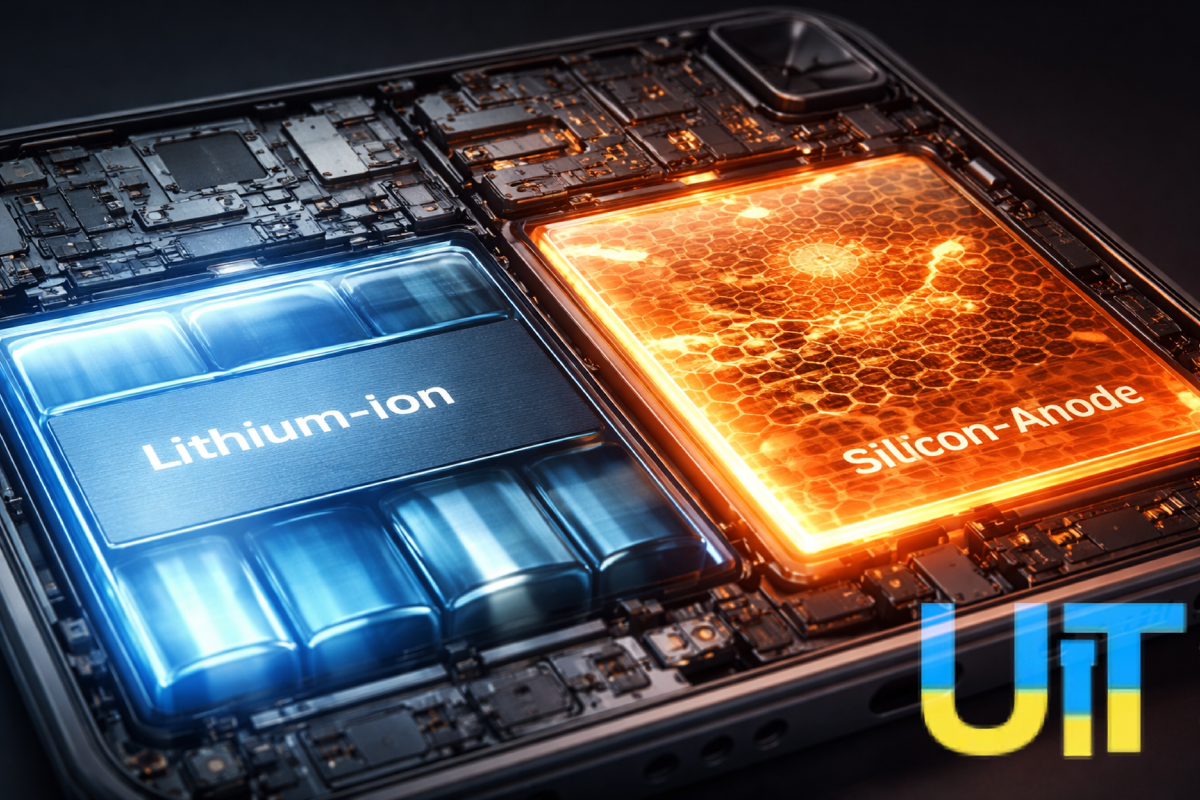
Forget about charging your phone every day — Chinese brands are once again raising the bar for battery life. While Apple, Google and Samsung carefully stay within the 4,500–5,000 mAh range, vivo is preparing a smartphone with a battery of up to 12,000 mAh. But does this mean lithium-ion batteries are outdated, and why aren’t global manufacturers rushing to adopt silicon-based batteries with record capacity?
The 2026 smartphone market is actively discussing silicon-carbon batteries and higher energy density in mobile devices. After the news about vivo’s 12,000 mAh battery, battery life has once again become a central topic in the Android segment, especially amid rising processor power consumption and 5G usage.
Silicon vs Lithium-Ion Batteries in 2026: Battery Life, Degradation and Real Risks
Traditional lithium-ion batteries have long been limited by physics: increasing capacity usually means increasing size or weight. Silicon anodes allow higher energy density without significantly thickening the device, but they also raise questions about stability, heat management and long-term degradation.
Main differences between the technologies:
- lithium-ion batteries use a graphite anode and well-tested chemistry;
- silicon-carbon batteries partially replace graphite with silicon;
- silicon can store more lithium ions;
- higher energy density enables greater capacity in the same volume;
- material expansion during charging puts additional stress on the battery structure.
Silicon expands much more than graphite during charging, and this is the key engineering challenge. Manufacturers use composite structures to reduce internal stress and stabilize charge cycles. The technology is evolving rapidly, but it has not yet become fully mainstream in global flagship devices.
Capacity measured in mAh does not directly equal battery life, but it provides a useful benchmark. In 2026, most Android and iOS flagships last about 1–1.5 days under mixed usage — social media, camera, navigation and video.
Vivo is preparing a smartphone with a 12,000 mAh battery
Vivo is working on a smartphone with a battery capacity of up to 12,000 mAh — nearly double the standard capacity of most modern devices. If released, this model could significantly reshape expectations around battery life and daily charging habits. We break down what such capacity really means in practice and whether the market is ready for ultra-large batteries.
A smartphone with 12,000 mAh could theoretically deliver 2–3 days of battery life or more than 15–20 hours of active screen time, depending on the chipset and software optimization. However, processor efficiency, display brightness, 5G, AI features and background processes all play a major role.
What affects real-world battery life:
- chip manufacturing process and energy efficiency;
- Android or iOS optimization;
- display refresh rate;
- thermal control and throttling;
- charging speed and current management.
Even 5,000 mAh in a well-optimized device can outperform 6,000 mAh in a poorly optimized one. That’s why major brands focus not only on capacity numbers, but on balancing battery life, weight, device thickness and safety.
Apple, Samsung and Google operate on a global scale with hundreds of millions of devices sold. For them, predictable battery degradation and long-term stability are more important than record-breaking capacity figures.
Current challenges of silicon batteries:
- accelerated degradation if expansion is not properly controlled;
- more complex thermal management;
- need for advanced battery management systems;
- limited long-term real-world data over 3–4 years;
- stricter certification requirements in different markets.
No global manufacturer can afford widespread battery-related issues. After past industry incidents, safety became a decisive factor. As a result, new battery chemistries are introduced gradually and only after extensive internal testing.
Longevity is also an important context. Many users still have a working iPhone 8 released back in 2017.
Yes, the battery may have degraded or been replaced, but the device itself continues to function years later. This 5–7 year stability horizon is what users expect from Apple, Samsung and Google flagships.
Silicon-carbon batteries are not considered inherently dangerous and undergo standard certification processes. The concern is not about explosions, but about long-term chemical stability and performance after hundreds of charge cycles.
That is why Google Pixel, iPhone and Samsung Galaxy flagships typically remain in the 4,500–5,500 mAh range. They compensate with system optimization, efficient chipsets and software-based power management.
Chinese brands are actively testing the limits of battery capacity by using silicon anodes to increase energy density without significantly increasing thickness. If the technology proves stable over several years of real-world use, we will likely see gradual adoption in global flagship devices.
For now, the strategy of major companies appears pragmatic: better a stable day and a half of battery life without risk than three days with uncertain longevity. Battery life is becoming a new battlefield, but durability and predictability remain more important than marketing numbers. That explains why 12,000 mAh batteries are currently seen in bold experiments rather than in mainstream global flagships.
Більше новин в телеграмі




One thought on “12,000 mAh Silicon Batteries vs Lithium-Ion: Why Apple, Google and Samsung Aren’t Rushing”