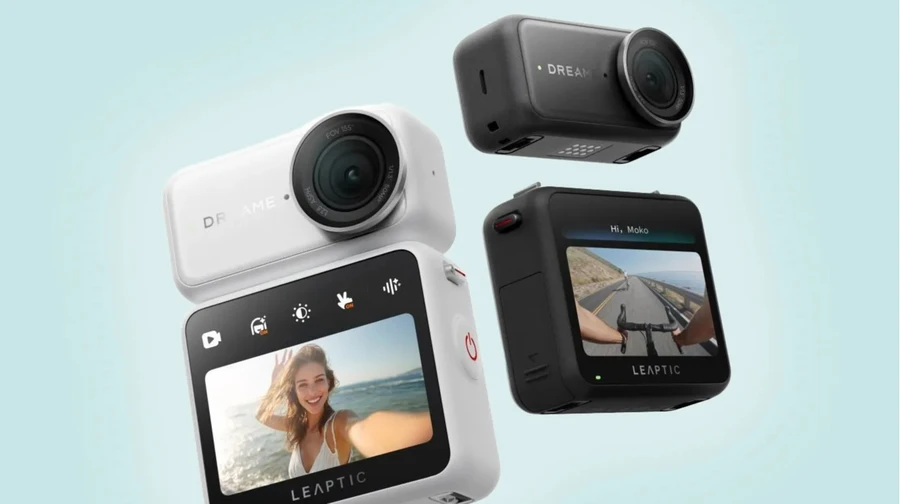
Dreame has stepped beyond its familiar world of robot vacuums and at CES 2026 introduced its first action camera — the Leaptic Cube. What matters here is not simply the brand’s debut in a new category, but how it did it: instead of releasing yet another 4K camera, the company enters the segment with 8K, a large sensor, and a modular design from the start.
8K 30 fps — not for show, but for editing
Leaptic Cube can record video in 8K at 30 frames per second.
8K in a compact camera is not about watching footage at that same resolution, because most displays cannot even show it. It is about having room for reframing. You can shoot a wide shot and later crop a part of the frame in editing without losing quality for 4K or even Full HD. For vlogs, sports, filming from a drone, helmet, or handlebars, this means you do not have to perfectly “guess the frame” while recording.
4K 60 fps with HDR and 4K 120 fps — choosing between dynamics and detail
The camera supports 4K 60 fps with HDR and 4K 120 fps for slow motion. 4K 60 fps with HDR is a mode for everyday scenes: travel, city videos, family footage, where color, contrast, and stable image quality matter.
4K 120 fps is for capturing motion: sports, tricks, water, fast transitions. You can slow down the footage smoothly while preserving fine detail. This is typically chosen not for “impressive numbers,” but for very specific shooting scenarios.
1/1.3” sensor — for difficult light, not studio conditions
At the core of the camera is a 1/1.3” format sensor.
The larger the sensor, the more light it can capture. This directly affects shooting indoors, in the evening, in overcast weather, and in shadow. Smaller sensors traditionally start to produce more noise and lose detail. Here, the focus is not on marketing claims, but on real image quality in challenging conditions where action cameras usually struggle.
155° field of view — wide, but controlled
The lens offers a 155° field of view. This is wide enough to capture the surrounding space: nature, roads, rooms, groups of people. At the same time, it is not an extreme “fish-eye” where everything is distorted at the edges. In practice, this means a balance between scene coverage and natural geometry that does not require aggressive correction in post-production.
Modular design — and that is the most interesting part
Leaptic Cube consists of two parts: the camera module and a separate screen. You can simply remove the screen, detach it from the camera, and monitor the shot from up to 30 meters away. For example, you can attach the camera to a dog’s collar and see everything through its perspective.
You can mount the camera on a helmet, handlebars, a tripod, or in the corner of a room, while keeping the screen in your hand or nearby to monitor the frame in real time. This solves a classic action-camera problem: “I’m recording, but I don’t really know what is in the frame.” For vloggers, craftsmen, trainers, and for shooting from unusual angles, this is not a small detail, but a functional advantage.
AI features: not instead of the operator, but instead of manual settings
Dreame lists automatic framing, subject tracking, and voice control via the app. The idea is simple: you do not waste time constantly adjusting composition and exposure. The camera adapts to the scene, follows the subject in the frame, and allows you to control recording without physically touching the body. This is especially useful when you are filming yourself, moving, or working alone. However, one thing is important: only real-world use will show the actual value, because the quality of AI features varies greatly between brands.
Up to 220 minutes with an external battery — not a record, but about use cases
Dreame mentions up to 220 minutes of battery life with an additional battery module. This is not a promise of “shoot all day without breaks,” but it is already enough for long trips, events, or extended recording sessions without constantly changing batteries. At the same time, the base runtime without the module has not yet been disclosed, so it is too early to assess overall power efficiency.
What is still missing for the full picture
The most important details have not yet been announced by Dreame.
There is no price. And it is the price that will determine whether this is a real alternative to GoPro, DJI, and Insta360, or a niche product for enthusiasts.
There are also no independent tests of stabilization, real video quality, AI performance, or battery life in 8K and 4K modes. These are exactly the factors that determine whether “impressive numbers” turn into a practical tool.
Dreame Leaptic Cube is not just another camera with bold specifications. It is an attempt to bring flagship-level parameters — 8K, a large sensor, a modular design, and AI features — into a compact form factor that is usually defined by limitations.
Here, 8K provides editing flexibility, the 1/1.3” sensor delivers more stable results in difficult lighting, 4K 120 fps gives control over motion, and the detachable screen offers framing control where it was previously inconvenient or impossible.
Until pricing and the first real-world tests appear, Leaptic Cube remains a very promising but still unproven model. But in terms of product concept, this is not an experiment for the sake of experimentation — it is a logical attempt to rethink what an action camera can be in 2026.
Більше новин в телеграмі