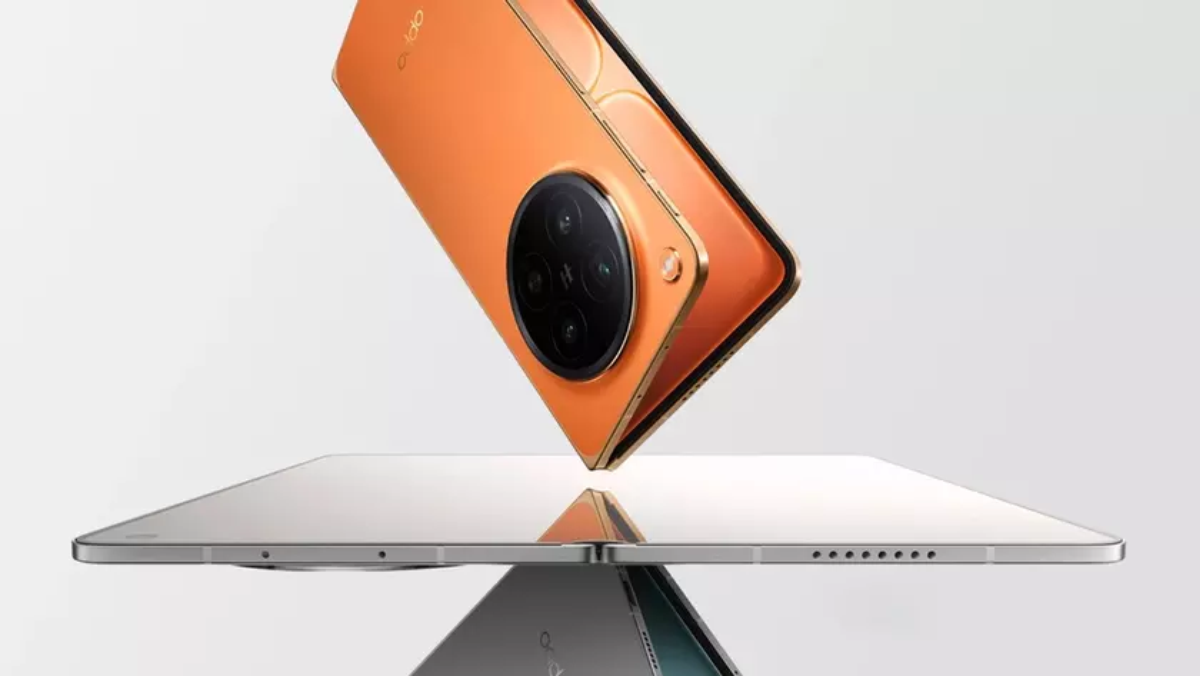
The foldable smartphone market long looked like an experiment for enthusiasts: expensive, interesting, but with obvious compromises. The Oppo Find N6 looks like the first device that finally closes that chapter. No loud claims — it simply removes the main issue that kept people from switching to foldable phones for years.
The smartphone that defeated the crease — Oppo Find N6
The irony is that the industry spent years convincing users to “get used” to the crease. Oppo chose a simpler path — it effectively removed it. And from that moment, the entire category starts to look different.
The foldable device market has finally moved from technical experiments to mature consumer technology. The new flagship Oppo Find N6 clearly shows that the main pain point of Fold-style devices — the visible groove in the middle of the screen — is essentially solved.
Engineers implemented an updated waterdrop-style hinge that doesn’t just fold the panel, but distributes stress across a wider bend radius. This makes the crease unnoticeable to the touch while scrolling and nearly invisible from most viewing angles. For users привыкших к монолитности классических смартфонов, это становится весомым аргументом наконец довериться гибким дисплеям.
Oppo Find N6 specs and 3000-nit display
Foldable smartphones have long lagged behind traditional flagships not only in trust, but also in basic display brightness. Due to the complex screen structure, manufacturers limited peak brightness — and it was noticeable.
The Oppo Find N6 fixes this without unnecessary noise. It simply delivers a number that feels like a challenge to the entire segment — and actually holds up in real-world use.
The internal 7.82-inch display reaches a peak brightness of 3000 nits. This ensures full readability even under direct sunlight — something that used to be a weak point for foldables.
LTPO technology enables an adaptive refresh rate from 1 to 120 Hz. Transitions are smooth, with no visible stutter when switching from static text to dynamic 4K video. Pixel density is balanced between both displays, so there’s no noticeable difference when switching from the outer screen to the inner one.
And here’s the key point: the display no longer feels like a compromise. It feels like the reason to buy this smartphone.
Oppo Find N6 Hasselblad cameras and optical zoom
Cameras have always been a weak spot in foldables. Limited space and complex design forced compromises. Oppo chose not to cut corners where it matters most.
The large circular camera module looks like a design choice, but it’s actually pure engineering. It simply provides the space needed for proper optics.
The partnership with Hasselblad goes beyond branding. The main sensor and periscope telephoto lens are tuned for natural color reproduction without aggressive processing. This is immediately noticeable, especially compared to overly saturated images from competitors.
Optical zoom captures distant objects with high detail and without digital noise. For such a thin foldable body, this is a serious engineering achievement.
As a result, the camera is not “good for a foldable” — it’s just good. And that alone changes how the entire category is perceived.
Performance and the nearly indestructible hinge
In short — the hinge is no longer a weak point. And that’s not marketing, but the result of material and structural changes.
The use of aerospace-grade alloys makes the hinge both lighter and stronger. This is engineering focused not on specs, but on real ощущения использования.
The hinge securely holds the screen at angles from 45 to 135 degrees. This unlocks practical scenarios that used to feel optional — video calls, work, and content viewing without stands.
Thermal management is also improved. The Oppo Find N6 remains stable under load, without brightness drops or throttling. This is critical in a foldable form factor where components are tightly packed.
And the overall feeling is simple: this phone doesn’t struggle under pressure. Which is not always the case even among traditional flagships.
Software adaptation and multitasking
A foldable without proper software is just a big screen without purpose. And this has been a major issue for the category.
The Oppo Find N6 feels like a device where software finally caught up with hardware. And you notice it not in settings, but in daily use.
The interface is optimized for the square aspect ratio. Split-screen works without limitations, and apps don’t feel stretched or broken.
Dragging files between windows, automatic adaptation to screen angles — everything works as a unified system. And that’s what turns the device into a tool rather than a showcase.
This is the moment where a foldable starts replacing a tablet — not partially, but fully.
Engineering stack: AI and next-gen connectivity
The Oppo Find N6 isn’t just about a new hinge and display. Internally, it’s also a major upgrade in connectivity architecture.
And what matters is not what’s supported — but how it impacts usage over time.
Wi-Fi 7 and Bluetooth 6 ensure stable connections even in congested environments. USB-C 3.2 Gen 1 allows fast file transfers, which is essential for editing and content workflows.
IP59 is particularly noteworthy. This is one of the few foldables with real protection against both water and dust — crucial for hinge durability.
In the end, these are not just features — they’re the foundation for long-term usability.
Workspace: stylus, multitasking, and AI
The Oppo Find N6 no longer feels like “a phone that unfolds.” It feels like a compact work device.
And more importantly — it adapts to the user, not the other way around.
- Stylus support. Enables full work with text, photos, and notes.
- Hybrid multitasking. Multiple apps running simultaneously.
- AI features. Context-aware assistance that reduces friction.
- Ecosystem integration. Seamless switching between devices.
This is the level where a smartphone becomes part of a workflow, not just a content consumption device.
Longevity and durability: why IP59 and Wi-Fi 7 matter
Buying a foldable is always about trust — not just in the brand, but in the technology itself.
The Oppo Find N6 rebuilds that trust through details that may not be obvious at first.
IP59 protects against dust and water. Wi-Fi 7 ensures future-proof speeds. Bluetooth 6 improves stability and battery efficiency. These are not features — they are the foundation.
And that foundation determines whether the device will still feel relevant in a few years.
The Oppo Find N6 looks like a device that didn’t just solve the crease problem. It addressed most of the reasons why people hesitated to buy a foldable in the first place.
More news on Telegram


More interesting articles
More interesting articles
Більше новин в телеграмі