At ElectricFish’s CES 2026 briefing, the company laid out a very specific answer to one of the hardest EV problems in North America: how to deploy fast charging at scale without breaking local power grids or spending years on utility upgrades.
The idea sounds simple on the surface — put fast chargers at existing gas stations — but ElectricFish’s approach is technical, grid-aware, and very different from classic DC fast-charging rollouts.
The core problem: fast charging and grid limits
Traditional DC fast chargers pull a large amount of power directly from the grid. In many parts of the US and Canada, especially at older gas stations or roadside locations, the local grid simply cannot deliver that power without expensive transformer upgrades, new substations, or multi-year permitting processes.
This is why many “planned” fast-charging sites never get built, or end up delivering far less power than advertised. The bottleneck is not the charger — it’s the grid connection.
ElectricFish’s solution: battery-buffered fast charging
ElectricFish sidesteps the grid bottleneck by decoupling charging power from grid capacity.
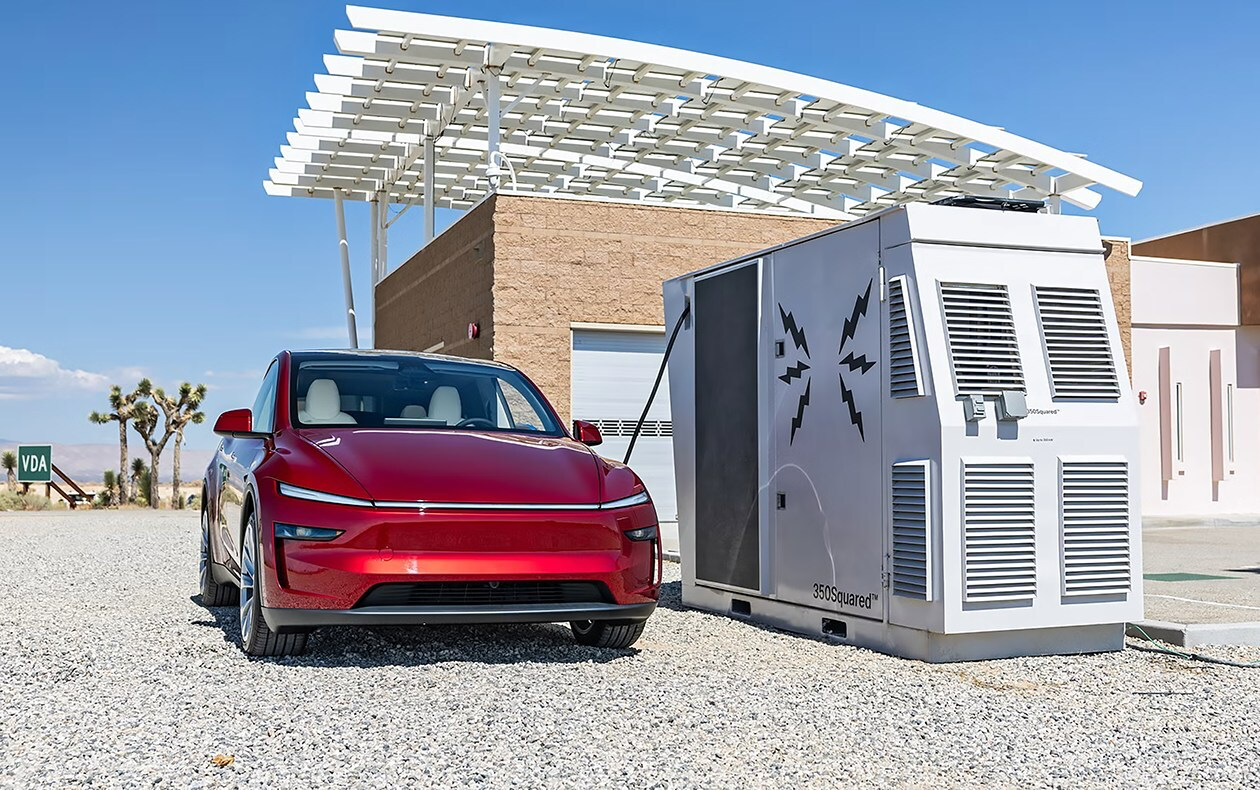
Instead of drawing peak power directly from the grid, ElectricFish stations integrate a large on-site battery system. The grid charges this battery slowly and steadily, staying within local utility limits. When an EV plugs in, the charger pulls high power from the battery, not the grid.
For the driver, this still looks like fast charging. For the utility, it looks like a predictable, low-stress load.
This architecture allows:
- Fast charging at locations with limited grid capacity
- Installation without major electrical upgrades
- Much faster deployment timelines
Why gas stations matter
Gas stations are already optimized for short stops, high vehicle turnover, and convenient access. They are also spread across urban, suburban, and highway locations — exactly where fast EV charging is needed.
ElectricFish’s system is designed to retrofit existing gas stations, not replace them. From an infrastructure standpoint, this is critical: it avoids land acquisition, zoning fights, and entirely new construction projects.
For station owners, this means:
- New revenue streams without grid overhauls
- Predictable energy costs
- Minimal disruption to existing operations
Grid benefits: not just “less harm,” but active support
One of the most important technical points ElectricFish highlighted is that its systems are not just grid-friendly — they can be grid-supportive.
Because the on-site battery can both charge and discharge intelligently, it can:
- Absorb excess power during low-demand periods
- Reduce peak demand stress
- Participate in demand response programs
In effect, each charging station can act as a small, distributed energy asset rather than a pure load.
Charging power and real-world performance
ElectricFish positions its stations as high-power fast chargers, suitable for modern EVs that support rapid DC charging. While the company does not frame this as a “spec race,” the emphasis is on consistent delivery, not peak numbers that collapse under load.
This matters more than headline wattage. A stable 150–200 kW delivered reliably is far more useful than a higher theoretical figure that the grid cannot sustain.
Deployment scale and North American focus
The company is explicitly focused on North America, where grid constraints, aging infrastructure, and long permitting cycles make conventional fast-charging rollouts slow and expensive.
By working within existing grid limits and existing real estate, ElectricFish aims to shorten deployment from years to months — a critical factor as EV adoption continues to accelerate.
Why this matters beyond CES hype
ElectricFish’s CES 2026 presentation stood out because it addressed a structural problem, not a cosmetic one. There was no emphasis on flashy screens or futuristic design language. The focus stayed firmly on:
- Electrical architecture
- Utility interaction
- Deployment realism
This is infrastructure thinking, not gadget thinking.
The bigger picture
As EV adoption grows, charging stops being a “nice to have” feature and becomes part of national energy systems. Solutions that ignore grid realities will hit walls quickly.
ElectricFish’s battery-buffered model suggests a more pragmatic path forward: use storage, respect grid limits, and build where drivers already stop.
If this approach scales the way the company expects, fast charging at gas stations could become less of a grid problem — and more of a grid solution.
Більше новин в телеграмі