
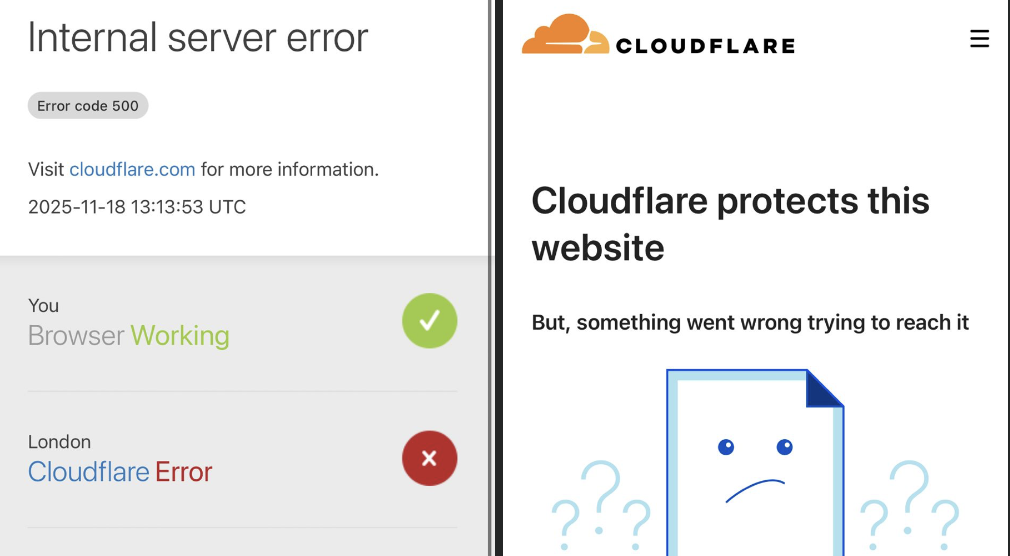
A major Cloudflare outage on November 19 caused global issues across websites, apps, payment systems and APIs. What was intended to be a routine configuration update resulted in widespread routing problems, service delays and partial downtime for thousands of platforms. In essence, one faulty file triggered a chain reaction that affected a significant portion of the modern web.
What happened
Cloudflare confirmed that the outage was caused by an error in a configuration update meant to improve network performance. Instead of optimizing traffic flow, the change disrupted the behavior of Cloudflare’s global Anycast network. In several regions, routing tables began to work incorrectly, causing delays and non-responsive servers.
Users around the world experienced:
- websites failing to load
- extremely slow server responses
- broken API services
- payment gateways timing out
- outages across apps relying on CDN caching
E-commerce, media outlets, gaming platforms, financial tools and corporate services were among the affected sectors.
Why one error can cause a global failure
Cloudflare’s network architecture relies on synchronized global configurations. When the company updates a rule — whether it’s related to caching, security or routing — the change propagates instantly to all data centers worldwide.
This model is efficient, but it comes with a critical risk:
a single mistake spreads everywhere simultaneously.
Experts compare this to a “global kill switch”: one incorrect parameter can destabilize huge parts of the internet in minutes.
What Cloudflare says now
Cloudflare rolled back the faulty configuration, and most services began recovering shortly after. According to the company:
- the outage was not caused by a cyberattack
- no data leaks or security breaches occurred
- the issue was purely human error
- internal review procedures for configuration updates will be improved
Cloudflare also warned that some regions may experience minor delays as global nodes finish re-synchronizing.
Why the impact was so large
Cloudflare handles more than 20% of global web traffic, providing services to:
- websites
- mobile apps
- API-driven platforms
- e-commerce systems
- financial services
- gaming ecosystems
Because the internet has become highly centralized, an issue at one major service provider can create a cascading effect across countless unrelated platforms — exactly what happened this time.
Conclusion
The Cloudflare incident is another reminder of how fragile global internet infrastructure remains.
Even with distributed systems and advanced routing, a single configuration file can disrupt services for millions of people worldwide.
Cloudflare has promised improvements to its review and rollout procedures, but the outage underlines a critical point:
the modern internet depends on a few key providers far more than most users realize.
Більше новин в телеграмі