
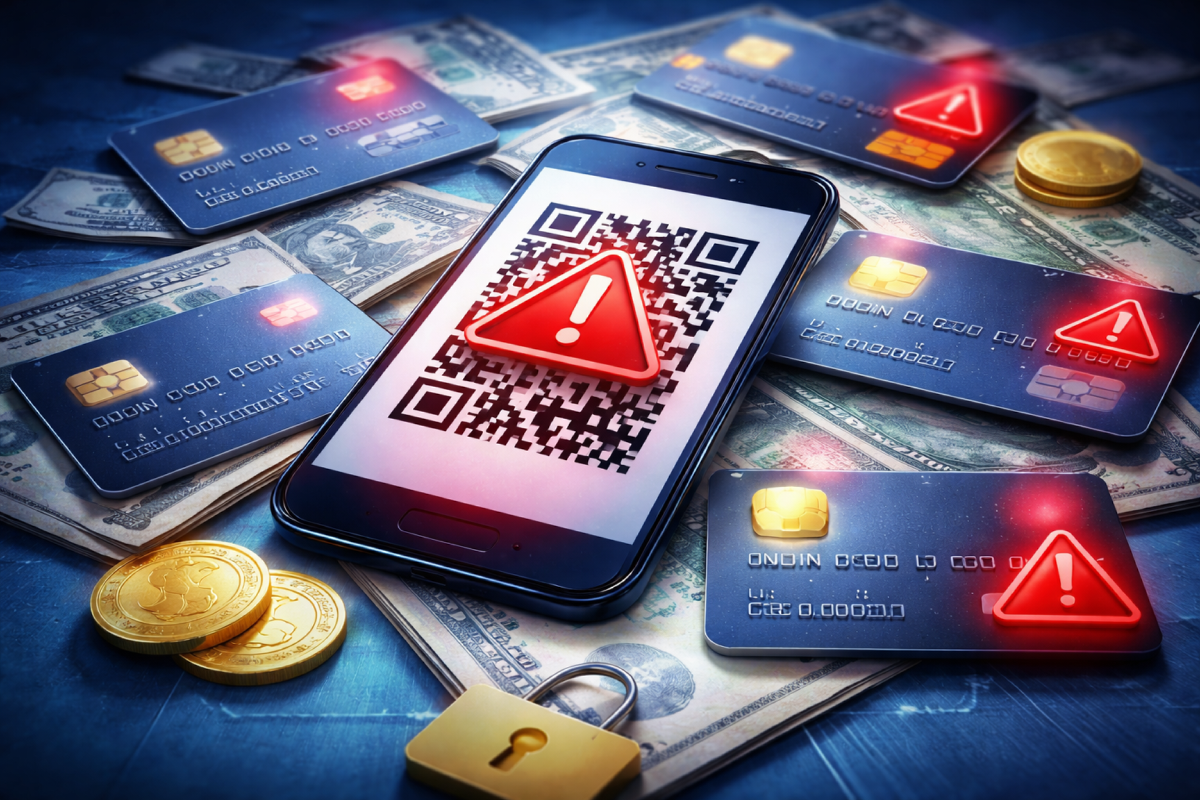
How often do we send money via a QR code or follow a link? Sometimes we lose not only the amount we just paid for a product, but all the money on the card — including credit funds. This usually doesn’t happen because a bank was hacked or a system failed.
In most cases, the problem is much simpler. We followed a link or scanned a QR code that looked normal and familiar, and made a decision we believed was safe at that moment. That single step is often enough for money to disappear.
Today, we’re not talking about fear or banning online payments. We’re talking about where the real point of failure is — and how to stop it without turning everyday digital life into constant anxiety.
How to check who we are paying
There are several practical ways to reduce risk before money leaves our account.
- Check the link or QR code we receive.
- Check the website where the payment is made.
- Use a separate card for subscriptions and online payments.
These are simple actions, but together they significantly reduce the chances of losing money to scams.
Checking links and QR codes
Links and QR codes are not dangerous by default. They are simply addresses that point somewhere else. The problem is that we usually don’t see where they lead until after we’ve already clicked or scanned.
There are advanced tools capable of collecting data at the moment of interaction, but they are expensive and rarely used in mass fraud. In everyday scams, attackers rely on something far more effective: human behavior.
Most fraudulent links and QR codes are designed to apply psychological pressure.
It may look like a request for help — “vote for a child,” “donate to victims,” or “support an urgent cause.” It may look like a familiar brand offering an unusually large discount for a very limited time. These pages often include countdown timers or urgent messages to push us into acting quickly.
In these situations, QR code payments become risky not because of the technology itself, but because decisions are made emotionally and without verification.
How to check where our money is going
The first and most important question is whether we truly know the person or project we are sending money to.
Even when it appears to be a public figure or a well-known organization, visual familiarity is not enough. Scammers frequently copy layouts, branding, and language to create convincing replicas of real websites.
That’s why the actual website or app address matters more than the name or design.
How to check a URL:
- look at the full web address, not just the brand name;
- watch for extra characters, numbers, or unusual domain endings;
- be cautious if the address closely resembles a known site but includes small differences;
- avoid shortened links that hide the final destination;
- be especially careful with links demanding immediate action or payment.
QR code scams and why they work
QR code scams often go unnoticed because scanning a code feels like a neutral, everyday action. We scan menus, parking meters, payment terminals, and delivery notices without thinking twice.
Fraudulent QR codes usually redirect users to fake payment pages or login screens that imitate trusted services. From the outside, everything looks routine. The danger appears only after sensitive data or payment details are entered.
This is why the real issue is not whether QR codes are safe or unsafe, but whether we take a moment to verify where they lead before completing a transaction.
How old is the website?
When paying online, we rarely think about how long a website has existed. However, a site’s age is one of the few objective signals that is difficult to fake.
Most scam websites are created for short-term use. They collect money, disappear, and reappear under a new name or domain. As a result, many fraudulent sites exist for only weeks or months.
A website that has been operating for several years usually has a very different profile.
Over time, it has:
- passed payment processor and compliance checks;
- had real users interacting with it;
- appeared in search engines, security databases, and banking systems.
This does not guarantee safety, but it filters out a large portion of short-lived scams.
How to check a website’s age
This takes only a few minutes.
By using a domain lookup service (commonly called WHOIS), we can see:
- when the domain was registered;
- how long it has existed;
- whether it was created very recently.
If a website asks for money but the domain is only a few months old, that alone is a reason to pause.
It’s also worth checking whether the site appears “alive” over time — older posts, updates, archived pages, or mentions outside the site itself. A few polished pages created quickly are not the same as a real operating project.
When an old domain suddenly comes back to life
Sometimes scammers don’t create a new domain. Instead, they purchase or reuse an old one that was inactive for years and launch a new site on it.
From the outside, such a site may appear established. In reality, it has no continuous history.
Warning signs include:
- a long-registered domain with all content appearing only recently;
- no archived pages or materials from previous years;
- no past mentions in search results or external sources.
An old registration date alone does not guarantee legitimacy if the site itself only became active yesterday.
A separate card for online payments
Most banks allow users to create a separate virtual or online card. Setting spending limits and using this card only for subscriptions or online purchases reduces potential losses.
It’s also safer to avoid entering card details on sites that do not support Apple Pay or Google Pay, since these services add an extra layer of protection.
If a scam does occur, a separate card helps protect the rest of your funds.
Another effective step is using a dedicated financial phone number. This number should not be used for social media, website registrations, or messaging apps. It should be reserved only for banks and payment services, reducing the risk of interception or account takeover.
In many cases, fraud doesn’t look suspicious. It looks like something we do every day: pay, donate, confirm, or avoid missing out. That familiarity is exactly what makes scams effective.
We can’t remove all risks from digital life. But we can make them smaller. Taking a few minutes to check a link, review a website, notice its age, or use a separate payment method is not paranoia. It’s basic attentiveness.
Online payments are here to stay. We buy, subscribe, donate, and support causes we care about. And all of this can be done safely — if we slow down just enough to make sure our money is going where we expect it to go.
Більше новин в телеграмі





One thought on “QR Codes and Links Look Safe — Until the Money Is Gone”