Read until the end — we will break down the technical “insides” of this newcomer and compare it with the MacBook Pro to understand if this device is worth the money.
Xiaomi laptops are often perceived as a compromise: a low price in exchange for savings on details. However, the Xiaomi Book Pro 14 of the 2026 model year completely breaks this stereotype. Despite being stubbornly called a “budget” device online, the real price tag starting from $1476 suggests otherwise. This is no longer the “cheap Xiaomi” we are used to, but a powerful professional tool based on the latest Intel Panther Lake processors.
Who is the Xiaomi Book Pro 14 for?
Instead of chasing record power, Xiaomi focused on comfort, yet the price indicates that we have a serious machine in front of us. This is a laptop for those whose day consists of dozens of browser tabs, Zoom calls, and working with heavy documents. The Xiaomi Book Pro 14 is not just a “balanced” device, but a machine tailored for a specific workload.
The base modification for $1476 offers an Intel Core Ultra 5 325 processor and 24 GB of RAM right out of the box. This volume allows you to keep over 50 tabs open in Chrome along with Slack and Excel running without any lag. For office workers, this reserve is perfect, although this version lacks productive Arc graphics.
If you need more, the mid-range version for $1648 on the Intel Core Ultra 5 338H chip with the Arc B370 video accelerator already allows you not only to work but also to play. According to test results, it delivers a comfortable FPS in most modern games at 1080p on low settings. At the same time, you get 32 GB of RAM and a 1 TB drive. This is by no means a budget device, but a bid to compete with the top models on the market.
Get breaking news on WhatsApp
The weight of 1.5 kg and a body thickness of 14.9 mm make it almost invisible in a backpack, and the battery realistically provides up to 8 hours of operation. You can safely take the laptop with you to classes or for remote work. The built-in camera and microphone system with noise cancellation guarantee clear communication in Google Meet even without a headset. You can conduct meetings or comfortably chat with friends. This is a laptop for those who do not want to compromise on memory or screen and are looking for a powerful Windows alternative to the MacBook.
The main trump card — the screen
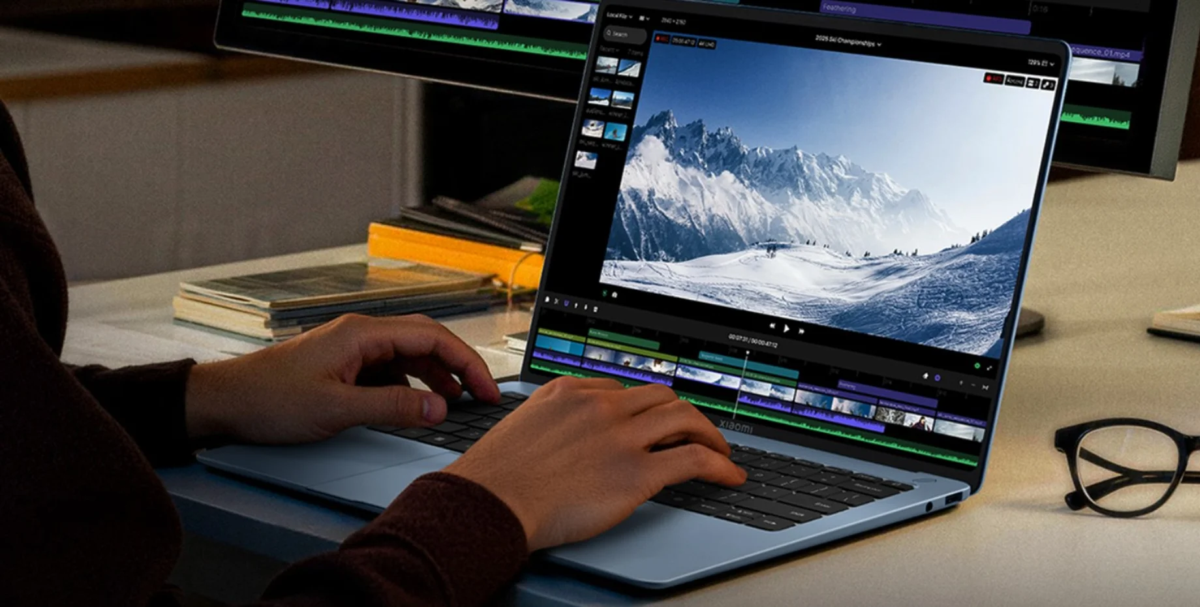
It features an OLED matrix (E4 from Samsung), which remains a weighty argument even at a price of fifteen hundred dollars. The resolution is 2.8K (2880×1800), which on 14 inches provides a pixel density of 242 PPI. The font looks “printed,” without any native graininess — this is exactly the level of detail you expect from a professional tool for working with text or code.
Tech Insights in Your Inbox
The peak brightness of 600 nits is a solid indicator, but the glossy finish can glare in front of a window on a sunny day. Therefore, either prepare an anti-glare film for the screen immediately or plan to work in the shaded side of the room. The 100% DCI-P3 color gamut guarantees that watching content on streaming platforms will be pleasant, and the picture will impress with the depth of the black color. Furthermore, processing photos taken on your Xiaomi will also be as convenient as possible — colors are displayed exactly as the smartphone manufacturer intended, creating a cohesive ecosystem for working with content.
A color error of Delta E < 1 allows you to confidently prepare layouts for printing without fear of incorrect shades. The screen is protected by Gorilla Glass 3 — this adds rigidity to the entire structure and makes the interface look visually more expensive. Although there is no touch control in this model, the glass panel creates that same “premium” effect usually inherent only in top-tier laptops.
Autonomy and Power
With such powerful hardware and an OLED screen, the energy issue is acute. The Xiaomi Book Pro 14 is equipped with a 56 Wh battery. In real conditions, this provides about 8 hours of work with text and mail at medium brightness. If you load the Intel Core Ultra processor with heavy tables or editing, this figure will drop to 4–5 hours. Here it loses to the MacBook Neo, which, thanks to its mobile architecture, holds a charge almost twice as long.
However, Xiaomi makes up for it with the speed of energy replenishment. The package includes a powerful 100W (GaN) power supply. Thanks to fast charging support, you can charge the laptop from 0% to 50% in just 35 minutes. This allows you to quickly “feed” the device during a short coffee break, which partially compensates for the smaller battery capacity compared to competitors from Apple.
Xiaomi vs MacBook for $1500 – couldn’t resist a comparison
When we put the Xiaomi Book Pro 14 and MacBook Pro (2026) side by side, it becomes clear: the “Chinese” contender tries to impress with figures in the specifications, while Apple offers a cohesive professional experience that so far remains out of reach for most Windows laptops.
- Screens
Xiaomi offers an excellent 120 Hz OLED matrix, and this is a huge step forward. But the MacBook Pro remains unreachable thanks to Liquid Retina XDR technology:
- Brightness. Xiaomi delivers 500–600 nits, which is standard for a good laptop. MacBook Pro provides 1000 nits consistently across the entire screen and up to 1600 nits in HDR. This allows you to work with color even on the terrace of a sunny cafe.
- ProMotion 120 Hz. In Apple’s case, this technology is adaptive and perfectly calibrated for the system, providing not just “smoothness,” but a feeling of instantaneous interface response.
- Autonomy. A marathon lasting two days (personally in my tasks).
The Xiaomi Book Pro 14 (2026) received a significant 72 Wh battery (and some modifications even more) and demonstrates excellent endurance for the Windows world. However, the MacBook Pro on the M5 chip is still ahead: it consistently lasts up to 20–24 hours of operation. You can work for two days without charging, and the laptop’s performance won’t drop by even a percent when you unplug the cable — something Intel Panther Lake cannot boast of yet.
- Memory and Architecture: Quality vs. Quantity
Xiaomi offers 32 GB of RAM for the price of a base Mac. This looks advantageous, but the Unified Memory architecture in the Apple M5 works differently: thanks to incredible bandwidth (up to 300 GB/s and higher), 16 GB in a MacBook Pro can work faster and more efficiently than 32 GB in traditional systems, especially when editing 8K video or working with neural networks.
- Ecosystem and Support
MacBook Pro is an investment. You get 7 years of guaranteed OS updates, the best speakers on the market, studio-quality microphones, and a trackpad with Force Touch that no one has been able to copy perfectly yet.
What does Xiaomi offer then?
The Chinese laptop won’t replace the MacBook Pro for those already “in the Apple system.” Its strength lies elsewhere:
- Best-in-class screen for Windows users. A 120 Hz OLED Touchscreen is something you won’t find among competitors for this money.
- Huge memory capacity (up to 32 GB), two SSD slots (upgradeable to 4 TB), and full-fledged ports (HDMI, USB-A) without the need for adapters.
- You get 90% of the capabilities of a top-tier ultrabook while saving a solid amount that can be invested in other hardware.
The MacBook Pro 14 is an uncompromising tool for those who need a perfect screen, cosmic autonomy, and support for years to come. The Xiaomi Book Pro 14 is the most powerful challenge in the Windows ultrabook segment, offering maximum technical specifications for those who value system flexibility and a professional OLED display.
Tech Insights in Your Inbox
Більше новин в телеграмі