
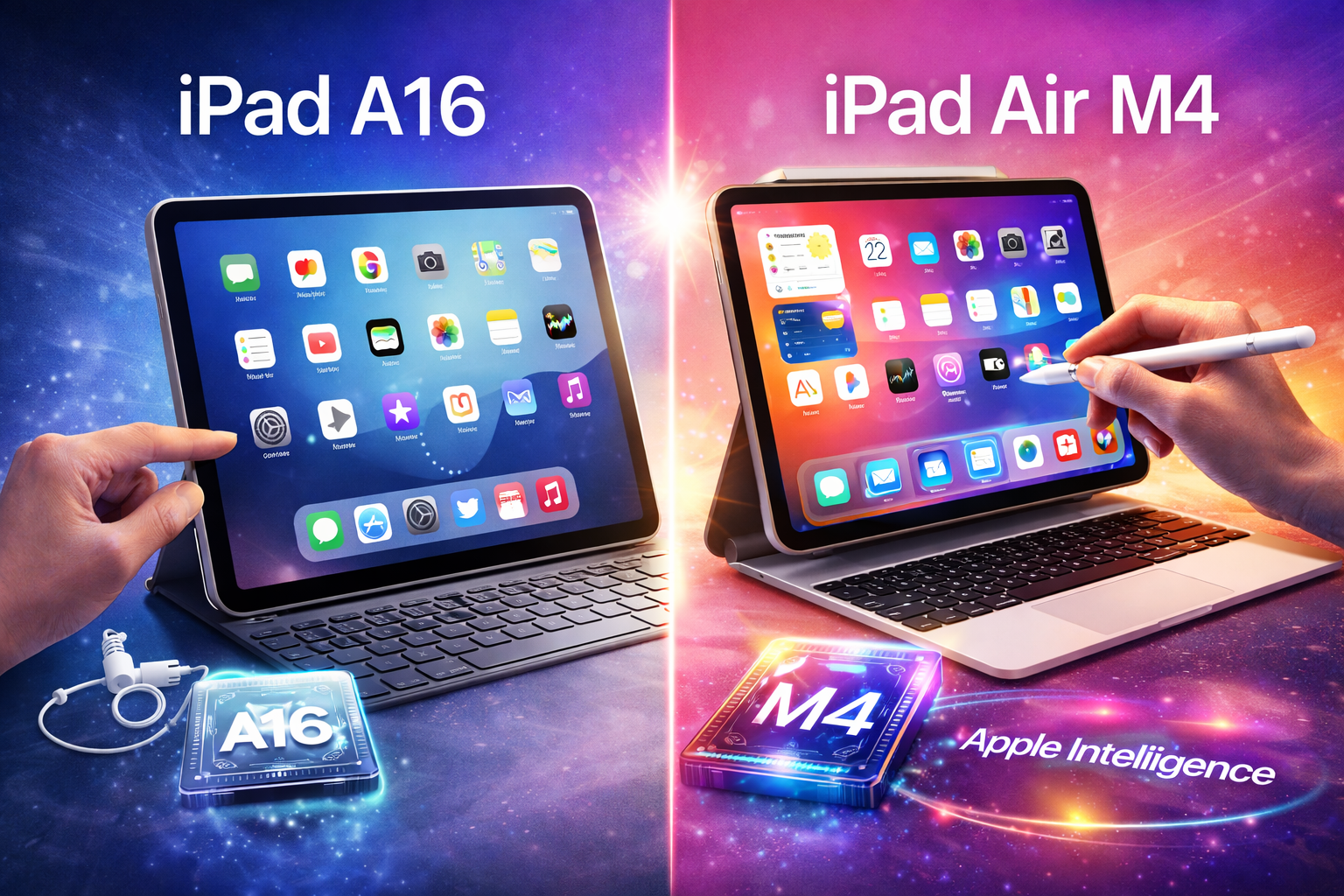
Today we’re answering a simple but important question: is it worth paying extra for the “Air” branding and the M4 chip, or is the base iPad with A16 more than enough?
We tested how they actually differ in real use, and here is a clear breakdown.
Display: what you actually see
At first glance, they look identical. But once you use them, the difference is obvious. The iPad Air has a laminated display. There is no air gap between the glass and the panel, so when you touch the screen, it feels like you are touching the content itself. The base iPad still has that gap, which creates a slightly hollow feel.
The Air also has a much better anti-reflective coating. If you work near windows or bright light, the difference is immediately visible. Color reproduction is also better: Air supports the P3 color gamut, which delivers richer colors and deeper blacks. For photo and video work, this matters.
Performance and real-world speed
The base iPad runs on the A16 Bionic chip. It is fast and reliable for everyday tasks like browsing, streaming, and social media. But the Air operates on a completely different level. The M4 chip brings laptop-class performance into a tablet.
Here is where the Air clearly pulls ahead:
- more RAM (12 GB vs 6 GB), which means better multitasking and no tab reloads;
- external display support with Stage Manager, allowing a desktop-like workflow (already available in the US);
- significantly faster USB-C speeds for transferring large files quickly.
Apple Intelligence: future-ready vs limited
This is the most important difference — Apple Intelligence. While still evolving, Apple is actively rolling out AI features such as writing tools, smart summaries, and contextual assistance inside the system (already available in the US in limited form).
The key limitation is hardware. The A16 chip does not support these AI features at all. It is not a software lock — the hardware simply cannot handle local AI processing.
Tech Insights in Your Inbox
The iPad Air with M4 is built for this future. Features like on-device AI processing, smarter Siri interactions, and system-wide intelligence are designed for chips of this class. If you want your device to stay relevant for years, this matters.
Accessories and usability
If you plan to draw, the Air is the clear choice. It supports Apple Pencil Pro, which includes squeeze gestures and haptic feedback (already available in the US). The base iPad uses older solutions that are less convenient.
Typing and productivity also differ. The base iPad works with Magic Keyboard Folio, while the Air supports the full Magic Keyboard with a floating design and trackpad, closer to a laptop experience.
Final decision
Choose the base iPad A16 if you need a simple, reliable tablet for media, reading, and everyday use. It offers great value and handles basic tasks easily.
Choose the iPad Air M4 if you want performance, longevity, and access to future AI features. It is not just a tablet — it is a long-term investment in the next generation of computing.
So what would you pick? Let me know whether AI readiness matters to you, or if it still feels like a promise rather than a necessity.
Більше новин в телеграмі