Tim Cook’s Dilemma: Why WWDC 2026 Will Be Apple’s Most Important Moment Since the iPhone
Cupertino, California. The sun over Apple Park in June 2026 shines just as brightly as it did ten years ago, but the atmosphere inside the “Ring” has changed. If WWDC once felt like a celebration of new features — Memoji, widgets, or colorful icons — today it has become a battleground for survival in an era where hardware matters less than neural networks.
WWDC 2026 is not just about unveiling iOS 27 or macOS 27. It is a final exam for the “Apple Intelligence” strategy that the company began rolling out two years ago. Can Apple prove that privacy and artificial intelligence can coexist, or will it become a follower in a world dominated by open models and fast-moving startups?
Part I: Siri 2.0 — From “I Don’t Understand” to “I’ll Handle It”
Over the past decade, Siri has been the subject of jokes. “Siri, set a timer” — for many users, that was the limit of its capabilities. But at WWDC 2026, we expect the unveiling of “LLM-First Siri.”
Tech Insights in Your Inbox
This is no longer just a voice assistant, but an agent-based model. The key difference in the new Siri, built on Apple Foundation Model 3, is system-level contextual awareness (On-screen Awareness). Imagine this: you receive a message in Telegram from a colleague with a photo of a lunch bill. You simply say, “Siri, calculate my share and send it via Apple Pay.” Today, this requires five apps and multiple steps. In 2026, Siri should handle it самостоятельно, by reading the image, identifying the contact, and completing the transaction in the background.
This requires massive computing power. That is why Apple is expected to introduce Private Cloud Compute 2.0 — a server infrastructure powered by M5 chips, designed to process personal data in the cloud with the same level of security as on-device processing. Apple is trying to sell the idea of “AI without surveillance,” and Siri is its flagship product.
But the key question remains: will the new Siri actually work, or will it once again fall short? And in which countries will it be available? As of 2026, Siri still does not officially support Ukrainian, and many Apple Intelligence features remain restricted outside the US and China. If Cook does not announce global language expansion, for millions of users this “intelligence” will remain just a polished demo on YouTube.
Part II: iOS 27 and the “Liquid Design”
If iOS 26 brought customization, iOS 27 will bring adaptability. The new interface concept, referred to by insiders as Liquid UI, is built on the idea that the interface should change depending on what you are doing.
Tech Insights in Your Inbox
- Dynamic spaces: apps on the home screen are no longer just icons. They become mini-widgets that expand when notifications arrive and shrink when not needed.
- Integration with visionOS: following the success of Vision Pro, iOS adopts spatial design elements. Shadows, depth, and transparency become more pronounced, making the iPhone screen feel like a window into another space.
- AI Search: iOS 27 will be the first OS where Spotlight is fully replaced by AI-driven search. Instead of searching for a “file,” you ask for “that document where I wrote about renovation expenses last Tuesday,” and the system finds it by analyzing content across apps.
Part III: The Final Goodbye to Intel
This is the moment anticipated (and feared) since 2020. Apple is expected to officially end support for Intel processors in macOS 27 (Tahoe). The last Intel-based Macs were released in 2020, and six years of support aligns with Apple’s standard. However, AI architecture requires a Neural Engine, which older processors lack. For owners of older MacBook Pro models, this marks the end of updates.
For macOS itself, this unlocks new possibilities. Developers will be able to implement features such as Real-time System Translation — instant translation of any audio or video at the system level — and AI-native apps that can communicate with each other without user involvement.
Part IV: Hardware — What Apple Might Show
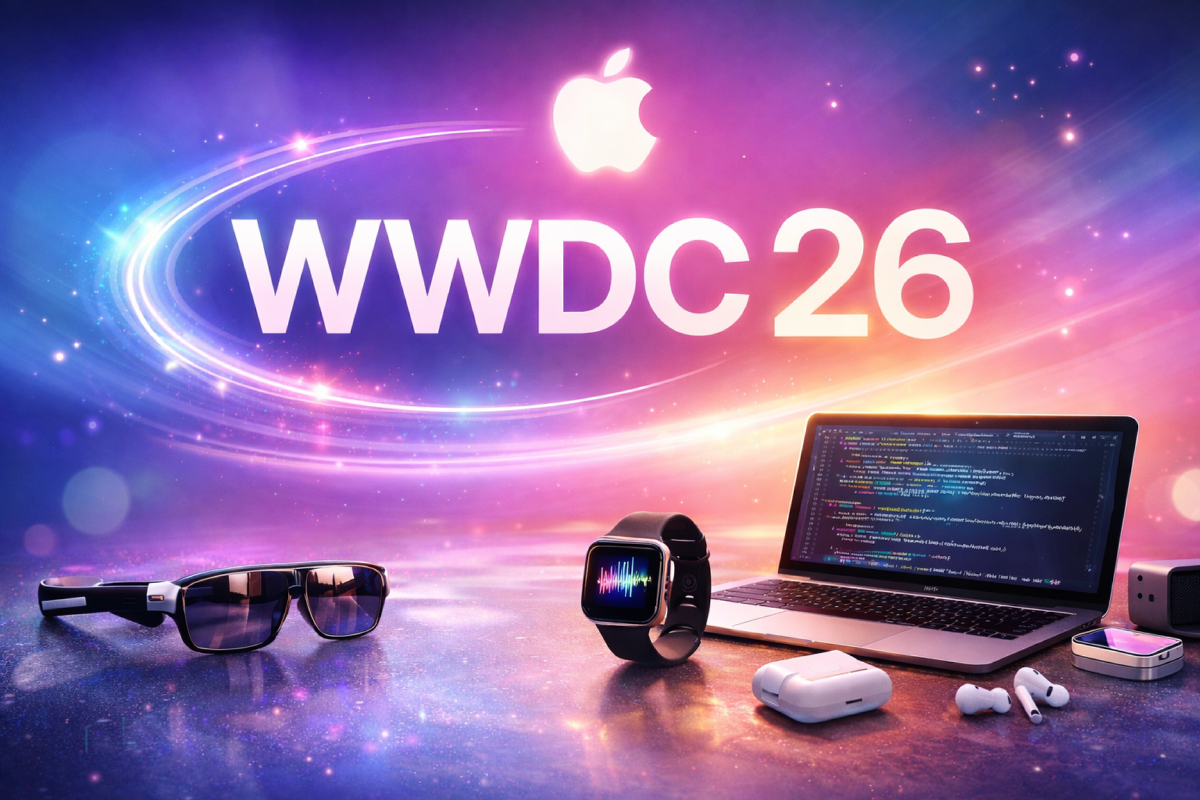
Although WWDC is traditionally a software-focused event, 2026 may be unusually rich in hardware. Apple needs to refresh its device lineup faster to meet AI demands.
- iPad mini 8: the biggest surprise. Against expectations, it may debut in June. The previous model is outdated for Siri 2.0. It is expected to feature the first OLED display in the lineup, an A19 Pro chip, and IP68 water resistance.
- Professional Macs (M5 Ultra): Mac Studio and Mac Pro powered by a 2nm TSMC process are expected. This could enable local execution of massive language models with hundreds of billions of parameters.
- Apple TV 4K (2026): a new set-top box with a built-in FaceTime camera, serving as a smart home hub with integrated AI for face and voice recognition.
- Apple Glass (Smart Glasses): a technical demo of lightweight glasses (similar to Meta Ray-Ban), without displays but equipped with cameras and speakers, acting as “eyes” for Siri.
- Updated accessories: Magic Keyboard and Trackpad переход to USB-C, along with a minor update to AirPods Max 2.
Part V: The “European Front” and Ethics
The political context cannot be ignored. In Ukraine and across the EU, Apple faces strict regulation under the DMA. At WWDC 2026, we may see the announcement of a “sovereign data” system, allowing users to choose which neural networks process their requests — Apple’s own models or integrated partner solutions like Google.
The Beginning of the “Post-App” Era
WWDC 2026 will be a turning point. We are moving from a world where we search for an “app” to complete a task, to a world where the device understands the task and uses the necessary tools itself. If Tim Cook can prove that Siri is not just a marketing concept but real intelligence in your pocket, the next decade may once again belong to Cupertino.
The world is watching. And this June may change how we interact with screens — or perhaps, finally, move beyond them entirely.
Більше новин в телеграмі