The Era of the “Living” Interface: How Google Gemini in April 2026 Rethinks Smartphone Logic
The smartphone is no longer just a collection of icons and folders. It has become an adaptive environment that does not wait for direct commands, but actively anticipates usage scenarios. As a result, we are witnessing a fundamental shift in how content is consumed, how code is handled professionally, and how daily productivity is structured. What once required dozens of clicks now happens in the background.
1. Design Philosophy: The Aesthetics of Cognitive Comfort
Google has fully moved away from the concept of “AI that impresses” toward “AI that doesn’t interfere.” In the April 2026 update, we see a triumph of minimalism, where technology becomes invisible until it is needed. This is a form of digital hygiene that allows users to avoid information overload.
New visual standards of 2026:
- Dynamic interface mimicry: The Material You 3.0 color palette now adapts not only to wallpapers, but also to the type of content. While reading technical documentation, the interface automatically switches to a “high focus” mode with muted tones that reduce eye strain.
- Elimination of visual noise: Gemini intelligently removes unnecessary notifications by grouping them into contextual “capsules.” They appear only when the user’s gaze focuses on the relevant area of the screen.
- Perceptual stability: With Fluid Motion 3.0 technology, animations have become so smooth that transitions between tasks feel natural, allowing users to work for hours without digital fatigue.
This approach is important not so much from an aesthetic perspective as from a functional one. The 2026 user spends more time in the system than ever before, so the interface must support a continuous “flow” state.
2. Deep Integration: Android as a Unified Organism
The main shift of April 2026 is the complete disappearance of the barrier between the operating system and artificial intelligence. Gemini is no longer an app that can be closed. It is the foundation upon which the entire Android 17 architecture is built.
How it works at the system level:
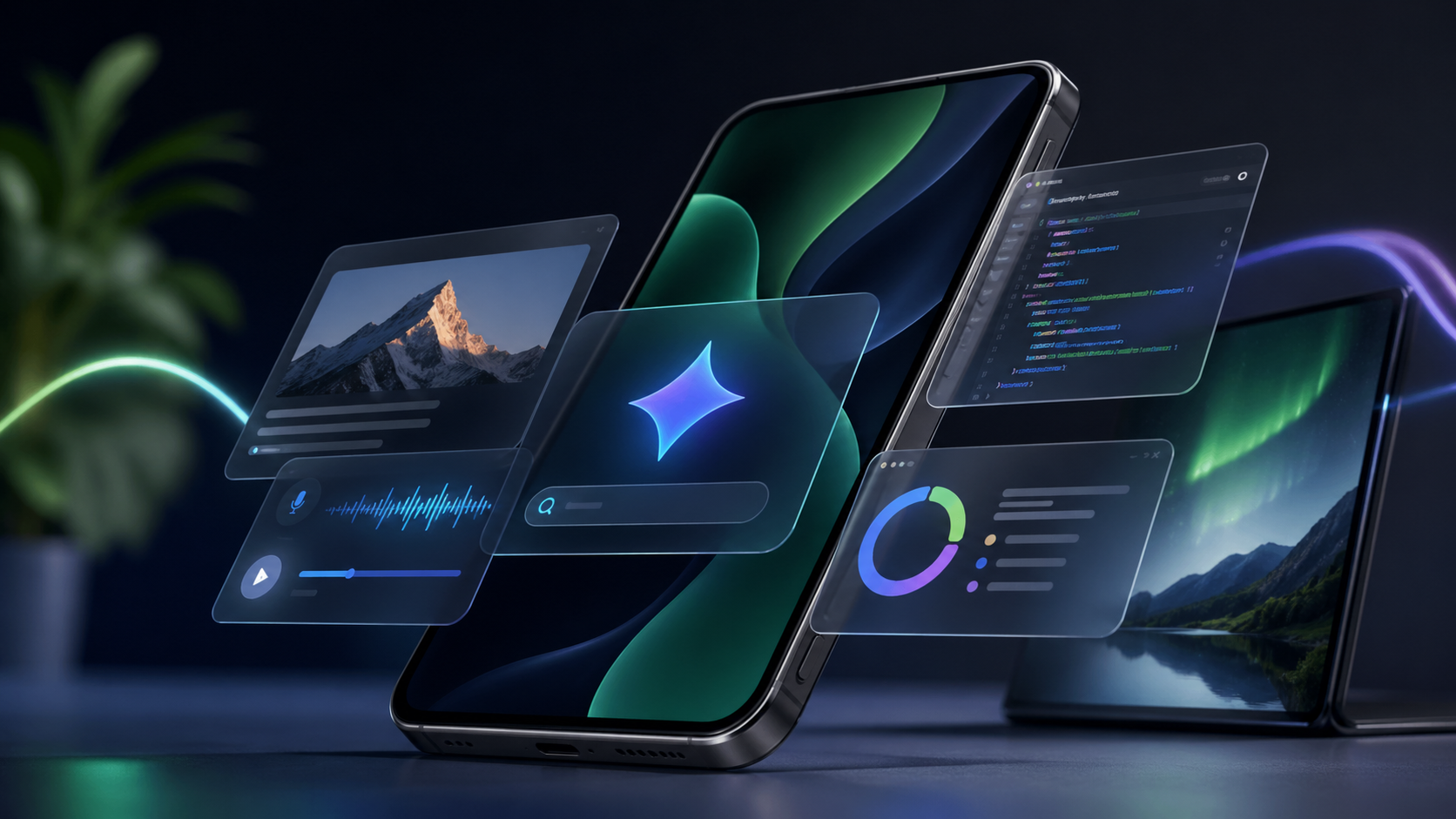
On-Screen Awareness: Thanks to new neural processors, Gemini “sees” and understands everything happening on the screen. For example, if you are discussing project details in Telegram, the system automatically prepares links to cloud documents and checks your calendar availability, offering actions as subtle suggestions.
Intelligent system menus: Static buttons like “Copy” or “Share” are becoming obsolete. They are replaced by contextual actions. If you highlight a piece of code, the system instantly suggests “Run in terminal,” “Optimize,” or “Find bug.”
AI is activated by behavioral triggers. The smartphone understands when you are working and when you are relaxing. During work hours, priority is given to processor resources for complex tasks, while in the evening Gemini shifts into a media assistant mode, filtering work-related content.
3. Multimodality 2.0: Real-Time Analysis
If in 2024–2025 multimodality meant simply uploading an image, by April 2026 it means continuous real-time processing of multiple data streams without delays.
Key content processing capabilities:
Live video analysis: You can watch a technical stream or educational lecture while Gemini creates structured notes in real time, extracts complex formulas, and explains professional terms as they appear.
Context-aware text generation: Writing replies to emails or messages is now based not on a single prompt, but on analyzing the entire interaction history with a contact across different communication channels, preserving tone and style.
4. A Revolution for Developers and the IT Sector
For the professional UITech Media audience, this update is a breakthrough. Gemini has evolved from a “code generator” into a full-fledged architect (pair programmer) capable of handling the logic of an entire project rather than individual functions.
New development tools:
- Deep logic auditing: AI analyzes architecture and identifies potential bottlenecks, suggesting memory optimization before compilation.
- Automatic documentation: The system describes code in real time, adding comments not only about what the code does, but why specific decisions were made.
- Seamless export: The ability to output clean HTML/CSS without unnecessary metadata makes Gemini an ideal tool for SMM and content managers focused on performance.
5. Optimization for Foldables and Flexible Devices
2026 became the turning point for foldable form factors. Google Gemini introduced a specialized adaptive mode that leverages the advantages of large, transformable displays.
The Drag-and-Drop Intelligence feature allows users to simply drag objects between windows to trigger complex actions. Drag a screenshot into a messenger, and the AI automatically suggests removing the background or adding context. On foldable displays, distributed multitasking is implemented: one side serves as a workspace, while the other becomes an intelligent Gemini control panel.
6. Security and Speed: On-Device AI
The biggest challenge—latency—has finally been addressed. With the Gemini Nano 3 architecture, most requests are processed directly on the device hardware. This ensures instant responses and an unprecedented level of privacy.
Your personal data, passwords, and message context are no longer sent to the cloud for processing. Everything remains on the device. This is not only secure but also energy-efficient: the new algorithms consume up to 40% less battery during active AI usage compared to last year.
7. UITech Media Forecast: What’s Next?
The April 2026 Gemini update marks the beginning of the end for the app-centric world. We expect the following trends:
- The disappearance of icons: In the next two years, we will see interfaces built around intents, where the system assembles the necessary tools based on the user’s task.
- Full automation of routine: SMM specialists and analysts will be able to delegate up to 80% of repetitive work to autonomous agents.
- Hyper-personalization: Your smartphone will differ not by appearance, but by thinking logic and feature priorities tailored to your professional activity.
Google Gemini is no longer just a text-generation tool. It is a complex, fast, and highly adaptive system that makes technology invisible. The smartphone has finally become a true extension of human intelligence.
Більше новин в телеграмі