Smartwatches from Google tend to divide opinions. Some users appreciate their clean Wear OS interface, native integration with the Google ecosystem, and distinctive circular design. Others frequently point out their modest battery life and the relatively slow rollout of hardware changes.
Despite the mixed feedback, development on the lineup is moving forward. The next-generation hardware—the Google Pixel Watch 5—recently cleared an essential regulatory hurdle by appearing in the US Federal Communications Commission (FCC) database. This certification is a mandatory step for any consumer electronics featuring wireless radios before they can be legally sold, meaning the devices are moving toward full-scale production.
Looking past the usual marketing hype, the regulatory data gives a clear picture of how Google is structuring its upcoming lineup and what hardware shifts are actually on the table.
The Four Variants: A Familiar Lineup Strategy
The FCC database reveals four distinct model numbers: G0F3Y, G1XJ6, G25QD, and GFW3R. While the consumer name “Pixel Watch 5” is absent from these dense technical filings, the numbering pattern and Google’s established release history leave little doubt about what these devices are.
The presence of four separate models points to a continuation of Google’s current hardware strategy. The company is retaining a two-size configuration, with each casing size split into two connectivity tiers:
- The Base Version (Wi-Fi and Bluetooth Only): Built for users who keep their smartphone close by. The watch relies on the companion phone’s data connection to handle notifications, routing, and background data sync.
- The LTE Version (Embedded SIM): Tailored for a more independent experience. This setup allows users to leave their phone at home during outdoor workouts while maintaining the ability to take calls, reply to messages, and stream audio directly to wireless earbuds.
This split addresses different consumer preferences, offering a choice between a smaller footprint for thinner wrists and a larger display paired with a higher-capacity battery.
The Move to Tensor G6: Efficiency and Performance
The most notable shift expected with this generation is the transition to a dedicated Tensor G6 chipset.
Early Pixel Watch generations relied on off-the-shelf processors from Exynos or Qualcomm. Google is now moving toward complete internal hardware design, mirroring the approach Apple takes with its custom silicon for the Apple Watch. The Pixel Watch 5 is expected to run an adapted version of the Tensor G6 architecture being developed in parallel for the upcoming Pixel 11 smartphone lineup.
For daily use, this silicon update targets three specific areas:
- Power Management: A more advanced fabrication process and updated core architecture aim to lower power draw during idle periods and active workout tracking.
- UI Responsiveness: Navigation between tiles and the launch times for heavier applications—such as navigation maps or media players—should see fewer micro-stutters.
- On-Device Processing: Google’s custom silicon is tuned for localized machine learning tasks. This hardware optimization should yield faster Google Assistant response times and more efficient sensor data analysis.
What the Regulatory Documents Leave Out
Because FCC filings are strictly limited to evaluating wireless communications (Wi-Fi, Bluetooth, LTE, and NFC for contactless payments), they do not confirm battery capacities, screen brightness levels, or new health tracking sensors.
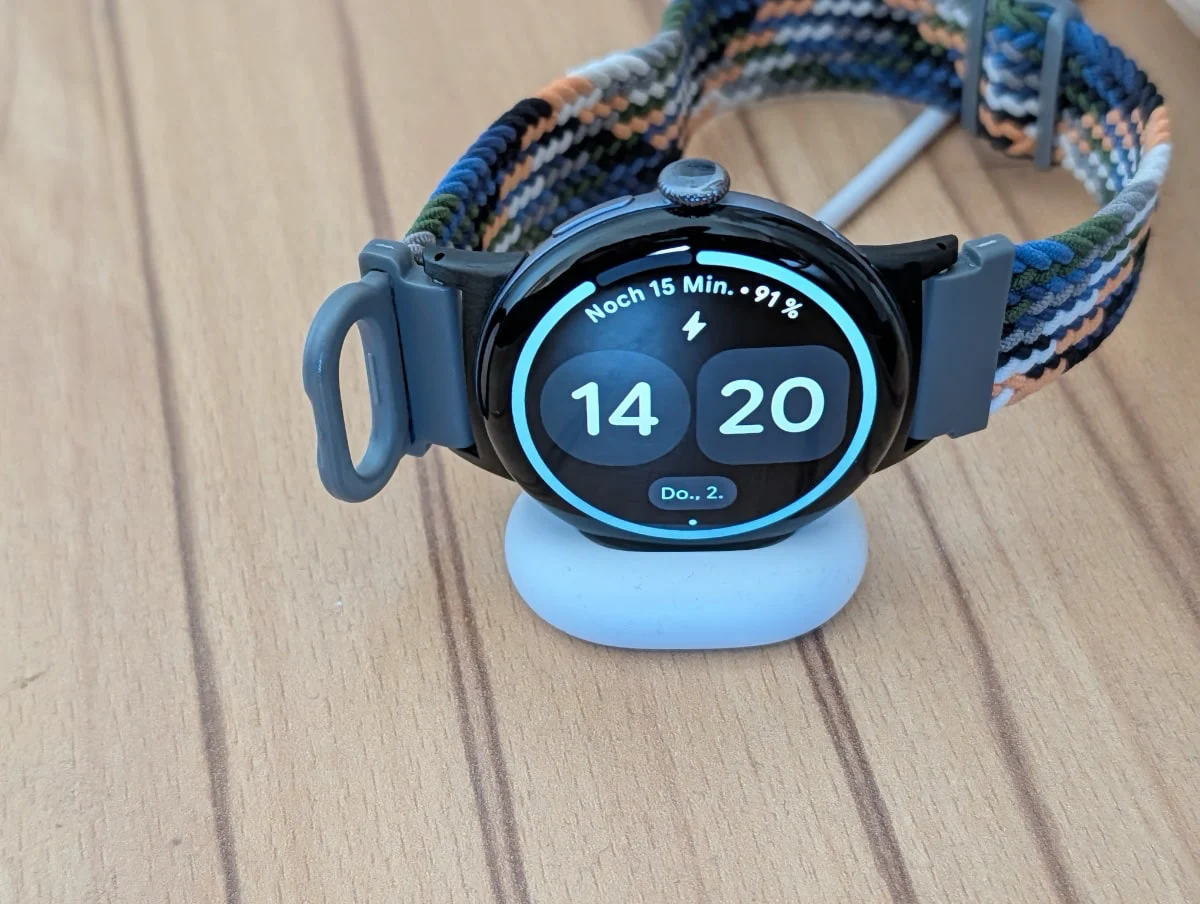
However, a few ongoing user pain points remain under close scrutiny. Charging mechanics are a primary example. While older generations faced criticism for relying on proprietary contact-pin cables rather than standard Qi wireless charging, the recent Pixel Watch 4 introduced a side-mounted two-pin Quick Charge Dock. Whether the Pixel Watch 5 will stick with this orientation or finally adopt a universal wireless standard remains unconfirmed.
The integration with the Fitbit health platform is also expected to evolve. Google has been systematically weaving Fitbit features deeper into Wear OS, suggesting this hardware iteration will bring updates to baseline metrics like sleep staging, stress tracking, and automated workout detection.
Timing and Market Outlook
An appearance in the regulatory database typically represents one of the final steps before a product’s market debut. Historically, a gap of a few months exists between these filings and the actual retail availability. All signs indicate that Google will stick to its autumn hardware schedule, introducing the Pixel Watch 5 alongside the flagship Pixel 11 smartphone family.
This update comes at an important time for Google’s wearable division. The company is trying to prove that its smartwatch platform has matured past the experimental phase, relying on custom silicon and tight software integration to compete directly with the industry’s established leaders. How effectively the new Tensor G6 chip addresses real-world battery constraints will become clear once the first retail units hit production.
Більше новин в телеграмі