OpenAI Introduces GPT-5.1
A major shift in how AI communicates and thinks
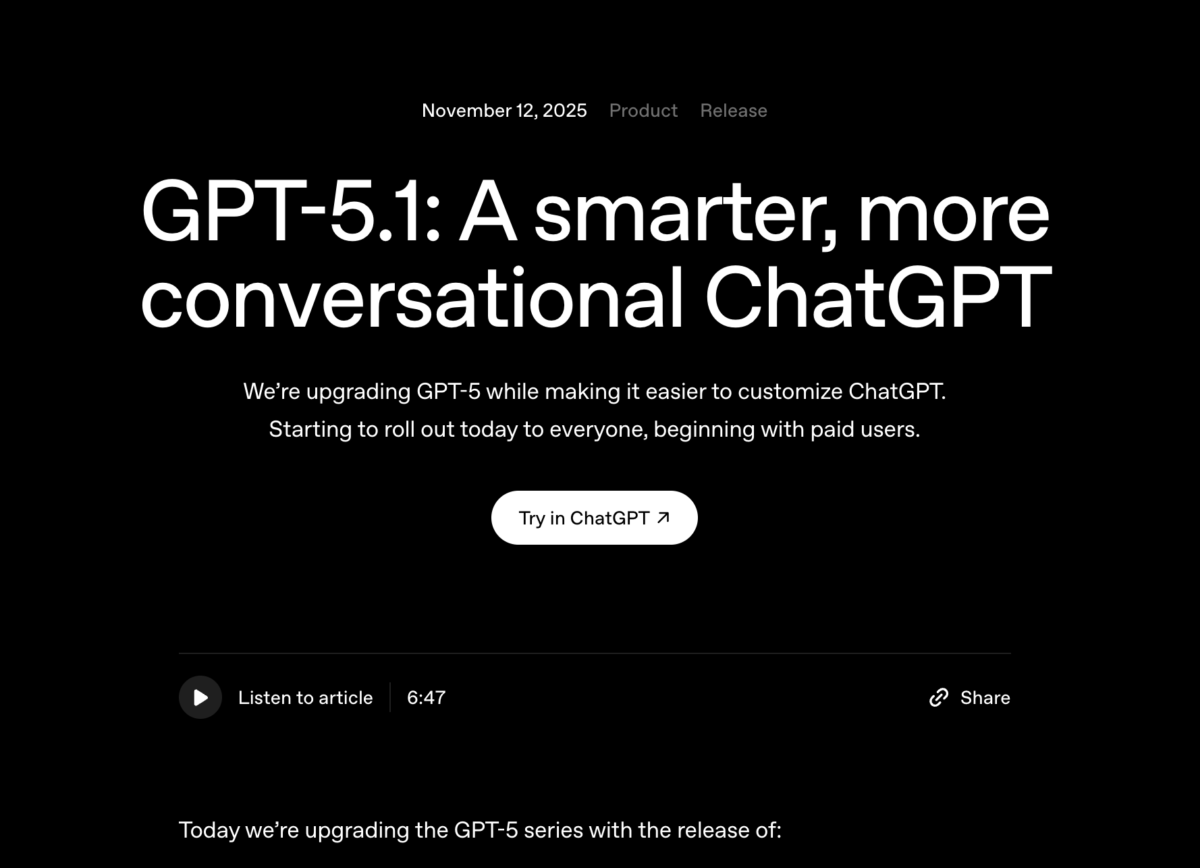
OpenAI has officially launched GPT-5.1, and this update marks an important step in how the model understands instructions, communicates with users, and handles complex reasoning. Instead of a single model for every task, OpenAI now offers two separate versions. GPT-5.1 Instant focuses on natural conversation and fast responses. GPT-5.1 Thinking focuses on deeper logical processing and multi-step reasoning.
The rollout has already begun for paid users, with free accounts receiving access in the following weeks. Previous models will remain in the Legacy section for around three months.
Instant Brings Back a More Human Style
Why users immediately notice the difference
GPT-5.1 Instant was created because many users felt GPT-5 became too formal, cold, and cautious. Instant restores the warmth and conversational tone that made GPT-4o so popular. The model responds more naturally, understands casual dialogue better, and uses humor in a more appropriate way.
Instant is built for messaging, brainstorming, creativity, social media content, quick explanations, and everyday tasks where speed and tone matter more than deep analysis. It feels like talking to a human who understands context and rhythm, without sounding robotic or detached.
Thinking Focuses on Deep Reasoning
A slower but more accurate and structured model
GPT-5.1 Thinking is designed for users who need precision. The model takes more time on complex prompts because it breaks down questions step by step. This approach results in clearer logic, fewer hallucinations, better interpretation of long documents, and a more consistent structure in answers.
Thinking is ideal for developers, analysts, journalists, students, researchers, lawyers, and professionals who require multi-stage problem solving. The model handles ambiguity better as well. Instead of improvising, it asks clarifying questions and waits for direction.
Improved Understanding of Complex Instructions
A model that follows human logic more consistently
GPT-5.1 Thinking shows major improvements in understanding layered or ambiguous tasks. It analyzes instructions more carefully, produces cleaner reasoning chains, and organizes answers in a way that reflects human problem-solving. OpenAI reports noticeably fewer hallucinations and higher accuracy across internal tests.
Two Modes, Two Ways of Using AI
Why this update matters more than a version number
GPT-5.1 introduces a fundamental shift. Instead of forcing one model to do everything, OpenAI now separates communication from reasoning. Instant focuses on natural conversation. Thinking focuses on deliberate analysis. This makes ChatGPT more adaptable for real use cases, because people rarely need both styles at the same time.
Instant is for fast, human-like interactions. Thinking is for complex work that requires accuracy and reflection. For the first time, users can choose not just the speed, but the thinking style of the model itself.
What Happens to Older Models
Legacy versions and transition timing
Previous models such as GPT-4, GPT-4o and others have been moved to the Legacy section. They will remain available for about three months before OpenAI gradually reduces support. GPT-5.1 becomes the default choice for ChatGPT and for developers using the API.
Availability and Rollout
Who gets access first
Paid subscribers already have access to both GPT-5.1 Instant and GPT-5.1 Thinking. Free accounts will receive the update gradually. Rollout times may differ depending on region, but OpenAI notes that the global distribution has already started.
Why GPT-5.1 Matters
A more flexible and more human AI experience
GPT-5.1 is important not because it raises a version number, but because it redefines what an AI assistant should be. Instant brings back warmth, personality, and natural communication. Thinking delivers improved reasoning and a level of structured analysis that earlier models struggled to achieve.
Together they make ChatGPT more accurate, more flexible, and more aligned with the way people in the US and Canada actually use AI in daily life and work.
Більше новин в телеграмі