Why screen privacy suddenly feels more relevant
I hate when someone tries to look at my phone. Not because I’m hiding anything, and not out of paranoia — it’s simply about personal space. Not long ago, a woman on public transit asked me what time it was and then commented that she couldn’t clearly see the numbers on my screen. It was a small moment, but a telling one.
Smartphones are no longer private objects once you use them in public. Your screen is visible to anyone standing close enough — whether you want that or not.
I use an iPhone and a Samsung Galaxy A34, so realistically I won’t be getting Samsung’s newest display ideas anytime soon. Still, the concept itself caught my attention. In daily life, you often need to pull out your phone quickly — to check a message, pay for something, open navigation. What you usually don’t want is for strangers to read your notifications along with you.
That’s why reports about a possible privacy display coming to the Galaxy S26 lineup feel different from the usual leaks. This doesn’t sound like a spec bump. It sounds like Samsung is rethinking how a screen should behave in public.
According to reports discussed by Western tech media, Samsung is working on a display that limits visibility when viewed from an angle. The company hasn’t given this technology an official name and hasn’t presented it as a finished consumer feature yet, but it has explained the general idea.
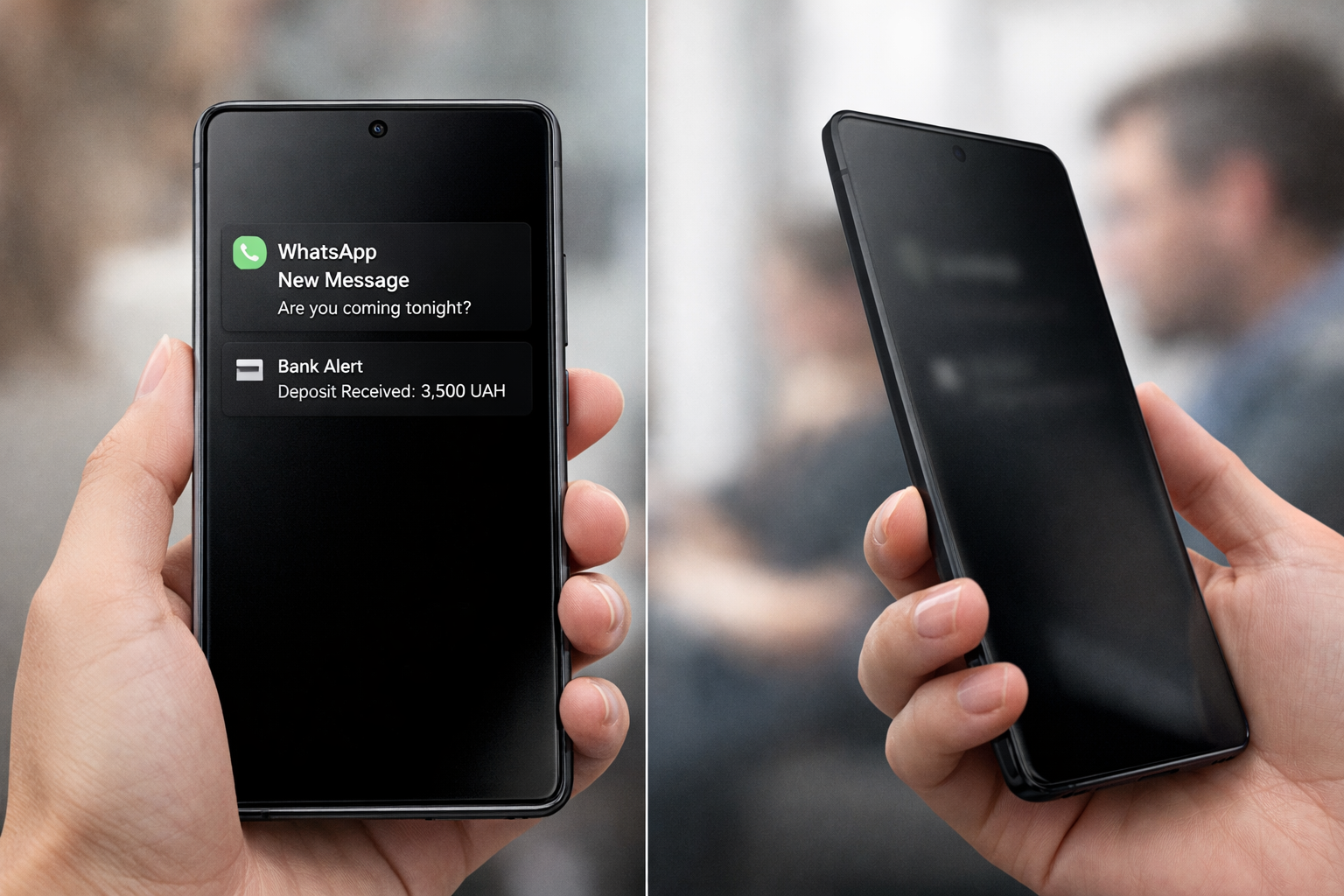
The screen remains fully readable when viewed straight on, while information becomes harder to see — or disappears entirely — when viewed from the side. This is very different from traditional privacy screen protectors, which simply darken the entire display and degrade image quality all the time.
How Samsung describes privacy screen controls
One important detail: Samsung hasn’t explained how the settings will work. The company only notes that the feature can be precisely configured, without going into interface-level details.
That wording suggests this isn’t a simple on/off mode. It’s reasonable to assume the system could allow selective hiding — for certain apps or specific types of notifications, rather than the entire interface at once.
Examples that have surfaced show notifications disappearing completely when viewed from an angle, while remaining perfectly readable from the front. If that’s accurate, this approach is far more practical than privacy films that permanently wash out the display.
At this stage, it’s unclear whether the privacy display will be limited to flagship models like the Galaxy S26 Ultra or become standard across the lineup. It’s also not clear whether the entire interface would be protected, or only specific elements.
Even partial control — for example, hiding notifications or sensitive UI elements — already sounds like a reasonable compromise.
This isn’t a feature designed for keynote slides or spec sheets. Its value becomes obvious in everyday use — when you need your phone quickly, but don’t want to share your screen with everyone around you.
If Samsung really allows users to control what stays visible and what doesn’t, that alone could meaningfully change how a phone feels to use in public.
That raises a natural question: will this feature come to other phones, such as the Galaxy S25 Ultra or older models? I have my doubts. Everything about this sounds less like software and more like a hardware-level change tied to a new display panel.
Even if Samsung recreates part of the idea through software — dimming elements or adding special notification modes — that would likely be an imitation. True angle-based visibility control requires a different panel, not just a new menu option. Whether such an imitation would be “good enough” is still an open question.
Which leads to another practical consideration: does it make sense to buy the Galaxy S25 Ultra now? If you frequently use your phone in crowded public spaces and care about screen privacy, that’s a personal call.
If privacy isn’t a major concern, there’s nothing wrong with buying the Galaxy S25 Ultra — or even the Galaxy S24 Ultra. Both models are expected to receive updates for years and remain solid flagship phones.
Thinking about upgrading right now?
If you’re considering a new Samsung flagship today, these are the models most people are looking at. You can check current pricing and availability below:
Samsung Galaxy S24 Ultra
A powerful flagship with long-term software support and a proven design.
Samsung Galaxy S25 Ultra
Samsung’s latest Ultra model, offering the newest hardware and features available today.
Більше новин в телеграмі